

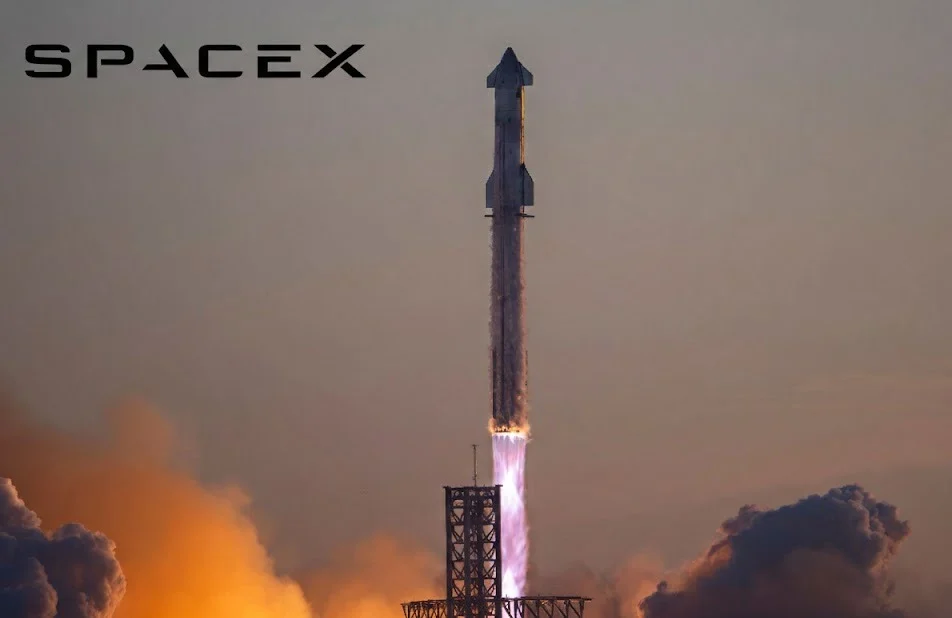
Image Credit: Space X
SpaceX’s Starship Flight 13 Scrub: When 29 Out of 33 Engines Just Isn’t Enough
A last-minute abort, propellant offloading, and a few days of patience before the next attempt
In the high-stakes world of rocket development, sometimes the most dramatic moments happen not during liftoff, but in the final seconds before it. That was exactly the case Thursday at SpaceX’s Starbase facility in South Texas, where the world’s most powerful rocket the towering 400-foot Starship remained firmly on the ground despite a seemingly flawless countdown.
What Happened
The launch team had their eyes on a 5:45 PM local time window, having loaded over 11.5 million pounds of liquid methane and liquid oxygen into the two-stage vehicle. Everything proceeded smoothly through the afternoon. Then came the engine startup sequence.
The countdown hit zero, but the rocket didn’t go anywhere.
SpaceX’s automated systems detected that not all 33 Raptor engines on the Super Heavy booster had ignited during the staggered startup sequence. According to the live video stream, four of the 33 engines never fired up, triggering an automatic launch abort.
The Immediate Aftermath
Elon Musk quickly took to X to provide updates, explaining that the team would need to offload propellant before attempting another launch. “Next launch attempt hopefully in a few days,” he posted. By later Thursday evening, he confirmed that ground crews would replace two of the Raptor engines on the booster, pushing the most likely launch timing to “early next week.”
Why This Matters
This scrub isn’t just a minor hiccup it highlights the immense complexity of operating a rocket with 33 engines working in perfect harmony. The Super Heavy booster’s Raptor 3 engines represent SpaceX’s latest generation of methalox propulsion, each capable of generating over half a million pounds of thrust. Getting all 33 to start reliably, both on the ground and during in-flight maneuvers, remains one of the program’s greatest technical challenges.
Flight 13 was supposed to be a significant milestone, building on the mostly successful Flight 12 in May. That mission revealed several engine-related issues:
- Booster flip maneuver: At stage separation, timing variability in engine startup caused the booster’s directional flip to be off by approximately 90 degrees
- Landing burn: Some booster engines failed to reignite, preventing a controlled splashdown
- Upper stage issue: One of the six Raptor engines on Starship’s upper stage shut down prematurely during Flight 12, forcing SpaceX to skip an in-space engine reignition test
For Flight 13, SpaceX had implemented modifications to the startup sequence to make it “more robust to timing variability.” The scrub suggests there’s still work to be done.
What’s at Stake
A successful Flight 13 would have checked several critical boxes:
- Controlled booster splashdown in the Gulf of Mexico (demonstrating V3 booster reusability)
- Successful in-space Raptor reignition on the upper stage
- Validation of corrective actions from Flight 12 issues
Beyond the immediate test objectives, each successful flight brings SpaceX closer to operational missions including Starlink satellite deployments, orbital refueling tests, and eventually, NASA’s Artemis lunar lander program.
Looking Ahead
SpaceX’s approach to development testing early, testing often, and learning from failures means a scrub like this is disappointing but not devastating. The team is already working on engine replacements, and the next launch window is just days away.
As Stephen Clark of Ars Technica notes, the company has already demonstrated booster recovery with the previous Starship V2 design. Now they need to prove it with V3, and that requires consistent engine performance from all 33 Raptors.
For space enthusiasts watching the live stream, the wait continues. But if history is any guide, Starship will fly again soon and the lessons learned from Thursday’s abort will make the next attempt that much more likely to succeed.
TechTrib.com is a leading technology news platform providing comprehensive coverage and analysis of tech news, cybersecurity, artificial intelligence, and emerging technology. Visit techtrib.com.
Contact Information: Email: [email protected] or for adverts placement [email protected]
About The Author
