

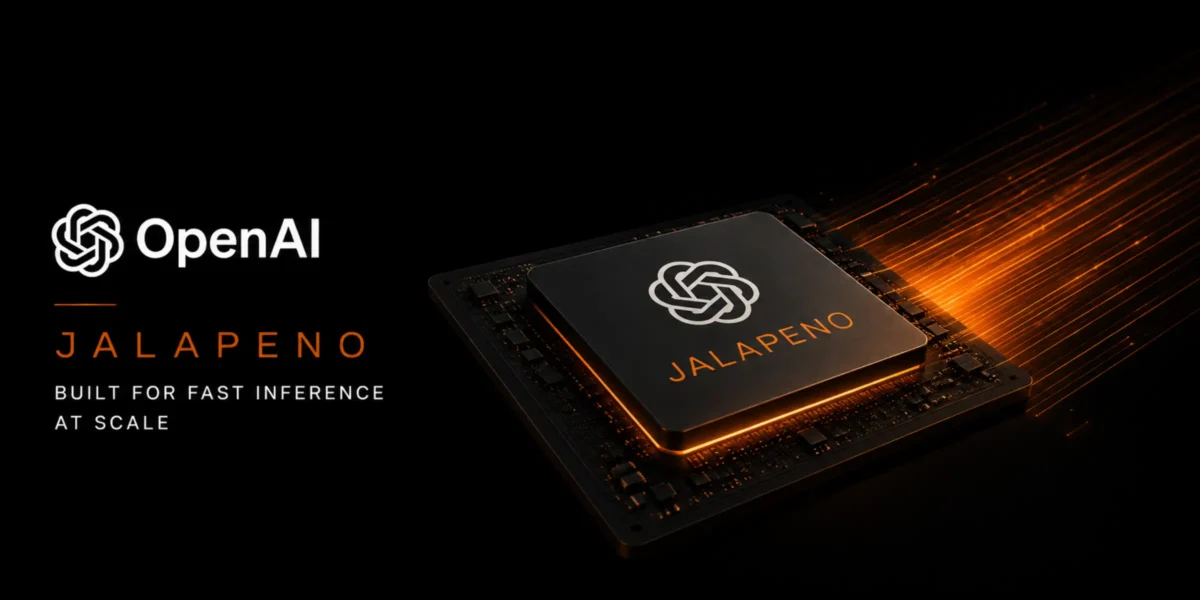
OpenAI Unveils Jalapeño Chip: A Game-Changer for AI Inference at Scale
At the prestigious Hot Chips conference on Tuesday, OpenAI offered the first detailed look at its custom-built AI processor, codenamed Jalapeño, alongside its initial benchmark results. The numbers are impressive: the chip demonstrates a “very, very significant performance advance over state of the art,” according to OpenAI’s head of hardware, Richard Ho.
A Chip Designed for Efficiency and Speed
Jalapeño is purpose-built for one of the most critical and resource-intensive tasks in AI: inference. This is the process where a trained AI model generates responses to user prompts, like when you ask a chatbot a question or use an image generation tool. The chip’s architecture focuses on two key metrics:
- More tokens per user: Jalapeño can process more chunks of data (tokens) efficiently, allowing for more complex and lengthy responses.
- More throughput per kilowatt: The chip delivers superior performance for every unit of power consumed, making it highly energy-efficient for serving AI models at scale.
According to tests performed on SemiAnalysis’ InferenceX benchmark, Jalapeño outperformed currently available state-of-the-art inference processors. Notably, this comparison was against an Nvidia Blackwell system, a current industry leader. The results suggest Jalapeño can serve a large number of customers efficiently while also providing low-latency responses, a crucial combination for real-world AI applications.
Full-Stack Optimization and Timeline
First announced in October of the previous year, Jalapeño was developed in close collaboration with Broadcom, with OpenAI’s own models assisting in the design process. The company envisions Jalapeño as the first in a multigenerational platform, where AI products, models, chips, and memory are all developed in concert. This full-stack approach allowed OpenAI to identify and address specific bottlenecks that often plague inference processing.
In particular, Jalapeño is engineered to minimize delays during the prefill (initial processing of a prompt) and communication phases, which often cause friction and slow down responses. By designing the system to minimize data movement, model states (like the key-value cache used during response generation) can be kept local and efficiently utilized.
The timeline for Jalapeño’s deployment is phased. Ho estimates that the chip will begin deployment at the end of 2026 “in very small volumes,” with more significant, large-scale deployment expected in 2027. It’s important to note that by the time Jalapeño reaches full deployment, the competitive landscape, including Nvidia’s offerings, will likely have advanced significantly.
Implications for the AI Industry
OpenAI’s move to develop its own inference chip is a strategic play to secure a critical part of its technology stack. By designing custom silicon, the company aims to optimize performance and efficiency for its specific AI models, potentially reducing costs and improving the user experience for its services. The success of Jalapeño will be closely watched, as it represents a major effort by an AI leader to reduce its dependence on general-purpose chip suppliers and tailor hardware directly to the demands of its cutting-edge models.
TechTrib.com is a leading technology news platform providing comprehensive coverage and analysis of tech news, cybersecurity, artificial intelligence, and emerging technology. Visit techtrib.com.
Contact Information: Email: [email protected] or for adverts placement [email protected]
About The Author
