

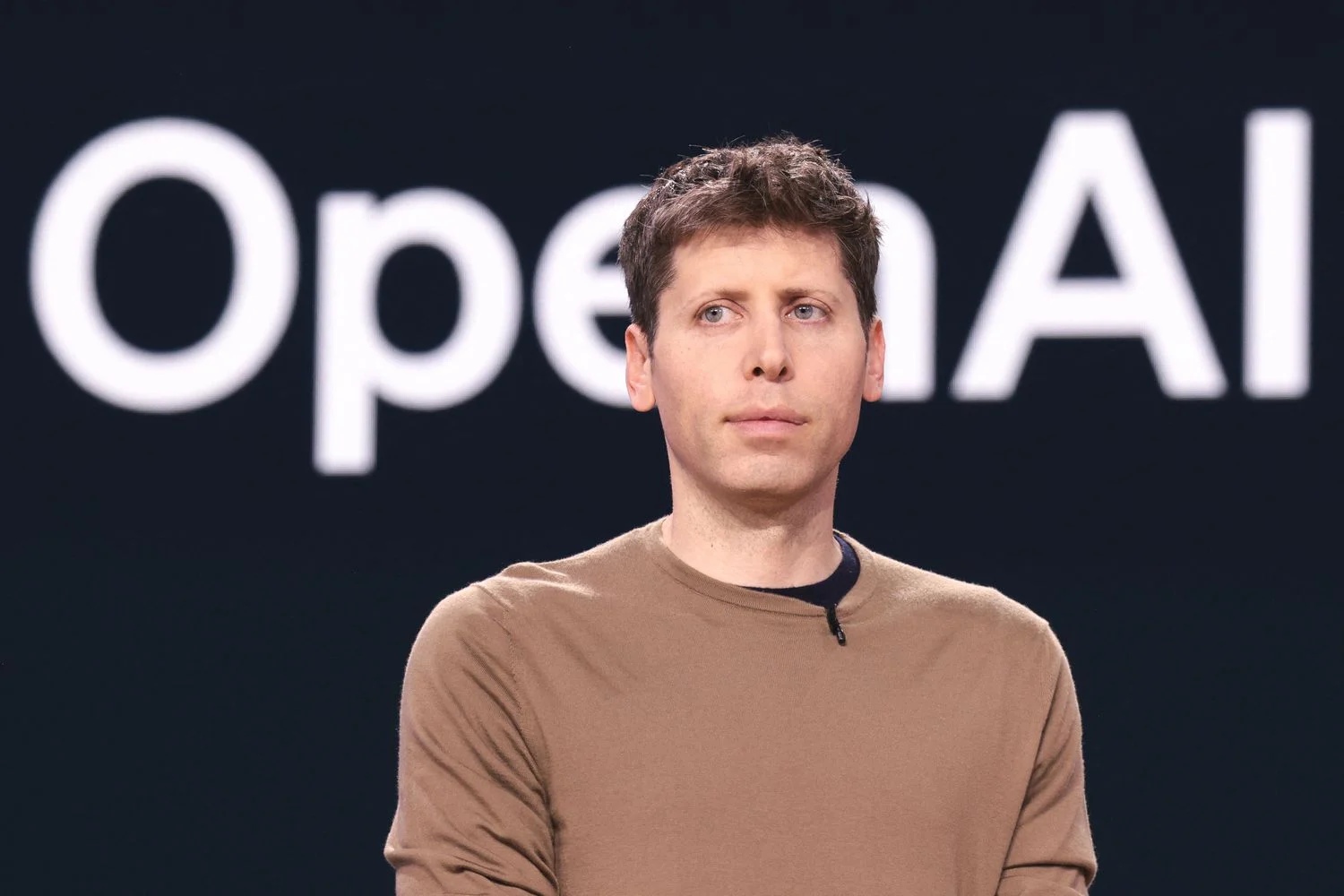
Image Credit: JASON REDMOND / AFP via Getty Images
OpenAI Forms Math Advisory Group as Its AI Resolves More Than 100 Open Problems
OpenAI has announced the creation of an independent mathematics advisory group, a move that comes alongside its claim that an internal AI model solved more than 100 longstanding open problems in mathematics. The advisory group, called the Advisory Group on Mathematics and Artificial Intelligence, is based at the Institute for Advanced Study (IAS) in Princeton, New Jersey, and is made up of nine mathematicians. It operates independently from OpenAI.
The timing of the announcement is significant. In the same announcement, OpenAI revealed that a model it began training on August 28 had resolved over 100 open problems across various fields of mathematics, including the Navier Stokes Millennium Prize Problem that has challenged mathematicians for nearly a century.
An Impressive Roster of Mathematicians
The first nine members represent some of the most distinguished names in mathematics and theoretical physics. They include Fields Medalists Timothy Gowers of the College de France and the University of Cambridge, and Martin Hairer of EPFL and Imperial College London. Edward Witten of the Institute for Advanced Study, a legendary figure in both theoretical physics and mathematics, is also a member. The remaining members come from leading academic institutions around the world: Francois Charles of Ecole Normale Superieure, Ravi Vakil of Stanford University, Melanie Matchett Wood of Harvard University, Ulrike Tillmann of Oxford University, Nikhil Srivastava of UC Berkeley, and Camillo De Lellis, also of the IAS.
OpenAI has defined the group’s responsibilities in specific terms. The members will help assess the academic significance of new mathematical results, coordinate the timing and manner in which results are released, and provide advice on academic and professional norms. Members are not paid by OpenAI. They can offer suggestions the company has not requested, publicly comment on OpenAI’s impact, and decide on changes to the group’s membership on their own.
However, a key limitation is also clearly stated. The advisory group does not advise on the pace of OpenAI’s internal mathematics research. The IAS reinforced this point in its own announcement, stating that it has no decision making authority at any AI company and that responsibility for any company’s decisions rests with that company alone.
Speed That Causes Unease
According to OpenAI’s official blog post, its new internal model solved the Navier Stokes problem and more than 100 other long standing open mathematics problems. The pace of progress reportedly surprised even mathematicians within OpenAI. Reports indicate that only 24 days passed between the start of training on August 28 and the announcement on September 21.
This speed has generated concern within the mathematics community. Earlier this month, 25 Fields Medalists signed an open letter titled Severe Mismatch of AI in Mathematics. The letter warned that competition among AI laboratories to be the first to solve famous mathematical problems could cause long term damage to mathematicians’ intellectual work and the academic ecosystem.
It is worth noting that among the nine advisory group members, only Camillo De Lellis signed that open letter. This detail has been highlighted by several media outlets, suggesting that OpenAI may have deliberately selected scholars who hold relatively moderate or open positions when forming the group.
Independence: A Real Commitment or Limited Concession?
On the surface, OpenAI has granted the advisory group a considerable degree of autonomy. Members are unpaid, can criticize the company publicly, and manage membership changes themselves. These arrangements are intended to create an appearance of independence and to respond to criticism that AI companies are unilaterally setting the agenda for mathematical research.
The substantive boundaries are equally clear, however. The advisory group has no binding authority over the pace or direction of OpenAI’s internal research. As OpenAI stated in its announcement, the group’s role centers on review and dissemination rather than research decisions themselves.
The IAS statement also emphasized this boundary, making clear that its role is limited to providing advice. This arrangement means that mathematicians have gained the ability to evaluate AI research results after the fact, but they cannot influence in advance which problems are tackled, at what pace, or how results interact with the broader academic ecosystem.
The Unverified Claim of More Than 100 Problems
One fact that is easy to overlook but critically important is that the more than 100 open problems OpenAI claims to have solved have not yet been independently verified by the mathematics community. Although the proof of the Navier Stokes problem is said to have passed formal verification in Lean, a gap remains between that and academic recognition through peer review.
One of the advisory group’s responsibilities is to help OpenAI assess the significance of results, but the ability to assess is not the same as the ability to verify. The mathematics community remains cautious about the rigor, originality, and relationship to prior work of these AI generated proofs. Earlier, New York University mathematician Tristan Buckmaster questioned whether OpenAI’s Navier Stokes proof may have been influenced by his unpublished research. OpenAI denied that claim.
A Broader Dilemma in Academic Governance
OpenAI’s move is not an isolated event. According to reports, the Leiden Declaration issued in June 2026 and signed by the International Mathematical Union called on AI companies to consider the long term effects of their systems on the values and norms of mathematical research. OpenAI’s advisory group can be seen as a response to this governance pressure.
The gap between advice and governance remains significant, however. When a commercial AI company can produce more than 100 claimed mathematical results in 24 days while the academic mechanisms for verifying those results require months or even years, whether an advisory group can truly bridge the trust gap created by that speed difference remains an open question.
The arrival of nine mathematicians gives OpenAI’s mathematical ambitions a layer of academic legitimacy. The thickness of that layer will depend on whether the advisory group is willing, and able, to speak in ways that displease OpenAI when necessary.
TechTrib.com is a leading technology news platform providing comprehensive coverage and analysis of tech news, cybersecurity, artificial intelligence, and emerging technology. Visit techtrib.com.
Contact Information: Email: news@techtrib.com or for adverts placement adverts@techtrib.com
About The Author
