

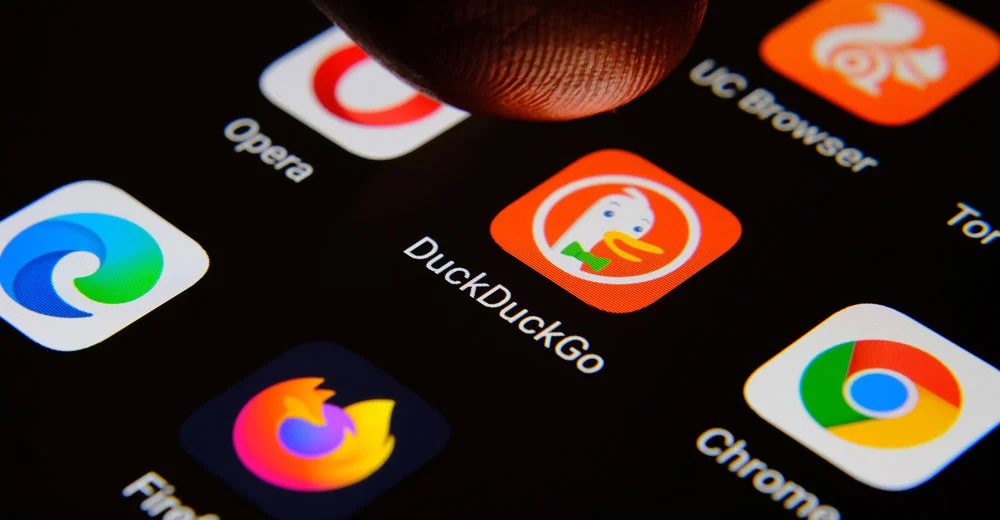
The Google AI Search Backlash: Why DuckDuckGo Is Winning While Google Pushes Forward
Forced AI integration has driven millions of users to seek alternatives, but is this a temporary revolt or the beginning of a lasting shift?
When Google announced last month that it would transform its traditional search box into a conversational AI engine, the company described it as ushering in “a new era for AI search.” But for many users, the change felt less like an exciting evolution and more like an unwelcome imposition. The result? A massive surge in installations of DuckDuckGo, one of Google’s long standing competitors.
According to a post on DuckDuckGo’s Bluesky account, installs on June 1 were 76 percent above the average before Google’s announcement. The company also broke its single day search record, and visits to its “No AI” search page have tripled since Google’s announcement, with numbers continuing to rise.
DuckDuckGo didn’t mince words about the significance of these developments. “It’s not a blip, it’s a movement. Fire Google,” the company wrote.
But what’s really driving this exodus? Is it a genuine rejection of AI technology, or something more nuanced? And can Google afford to ignore the backlash as it pushes forward with its AI vision?
A Case Study in How Not to Roll Out Change
Johan Konst, founder of EUSA PR, a tech public relations agency in Amsterdam, described Google’s handling of its new search rollout as a case study in how not to execute a product transition. “You don’t announce ‘the biggest change since 1998’ and then give users zero say in it and give them no other choice,” Konst told TechNewsWorld.
Konst characterized the move as a significant reputational gamble rather than a traditional product launch. “The DuckDuckGo surge is not a coincidence. It’s a direct consequence of a bad communications strategy,” he argued. “When you remove opt-out from a product used by 90 percent of the world, you don’t just frustrate users, you hand your competitors their best marketing campaign ever.”
The irony, according to Konst, is that DuckDuckGo’s most effective marketing team right now isn’t at DuckDuckGo, but rather the policymakers at Google who made the decision to force AI on users without providing a straightforward opt out option. This unintended gift to competitors has accelerated the adoption of alternative search engines in ways that traditional marketing campaigns could never have achieved.
The Strategy Behind Google’s Decision
Ross Rubin, principal analyst at Reticle Research, a consumer technology advisory firm in New York City, suggested that Google’s approach wasn’t taken lightly. “They’ve clearly been testing this for some time,” Rubin told TechNewsWorld. This wasn’t a rash decision but rather a carefully considered strategy based on extensive user testing and data analysis.
Google’s own data supports the direction they’ve chosen. According to a company blog post from Google VP for Search Elizabeth Reid, AI Mode has surpassed one billion monthly users just one year after its debut, with queries more than doubling every quarter since launch. Reid noted that as people have realized how much more Search can do for them, they’re searching more than ever before, with queries reaching an all time high in the last quarter.
This usage data suggests that despite the vocal backlash, a significant portion of users are embracing AI enhanced search experiences. The question becomes whether the long term potential of AI search outweighs the short term reputational damage and user exodus.
The Monopoly Factor and User Resistance
Greg Sterling, co founder of Near Media, a market research firm in San Francisco, argued that from a product perspective, it’s a mistake to force AI on people. “Google is basically able to act with impunity because it’s a monopoly,” Sterling told TechNewsWorld.
However, Sterling acknowledged that the situation is more complex than simple resistance to change. “I can tell you that people fundamentally like the flexibility of the AI experience and the fact that they can get immediate answers. But there is also distrust of AI. So users continue to embrace AI but with ambivalence.”
This ambivalence reflects a broader tension in how consumers relate to AI technology. They appreciate the convenience and efficiency that AI can provide, but they remain wary of accuracy issues, privacy concerns, and the loss of control over their information consumption. When a company forces AI upon users without offering alternatives, it triggers this underlying distrust and drives people to seek options that feel more familiar and controllable.
Growing AI Resentment
Kominos Chatzipapas, founder of Orion AI Software, a custom AI software developer in St. Petersburg, Florida, observed that while consumers were initially very enthusiastic about AI with the release of ChatGPT in 2022, there has been growing resentment toward AI over the past year. “I think that sentiment contributed greatly to the wave of traffic DuckDuckGo received,” he told TechNewsWorld.
Chatzipapas sees potential for AI search to become a positive development in the long run as hallucinations decrease, searchers become more accustomed to seeing AI overviews on search results pages, and Google finds ways to fairly compensate publishers to ensure a constant stream of good quality human content. However, the current implementation has clearly struck a nerve with users who feel the transition is happening too quickly and without adequate consideration for their preferences.
Control, Not AI Rejection
Mohamed Yousuf, CEO of Smart Workforce AI, a workforce intelligence platform based in Toronto, offered a crucial distinction about the nature of the backlash. “People aren’t resisting AI. They’re resisting having AI forced into products they already use,” Yousuf told TechNewsWorld.
Yousuf elaborated on this distinction: “Most consumers love AI when it saves them time or helps them solve a problem. What they don’t like is losing control over how they access information. The growth of DuckDuckGo is probably less about people rejecting AI and more about people looking for alternatives when they feel the experience they’ve become accustomed to is changing too quickly.”
This perspective suggests that the DuckDuckGo surge isn’t necessarily a rejection of AI technology itself, but rather a reaction to how it’s being implemented. Users want the benefits of AI without sacrificing the familiarity, control, and predictability of traditional search interfaces. When Google removed the ability to opt out, it eliminated the sense of agency that users value.
The Long Term View
Kadan Stadelmann, CTO and co founder of an AI platform in Dublin, Ireland, agreed that the resistance is primarily about mandatory implementation rather than AI itself. “Consumers adopt technology when they believe they are in control of the adoption, retaining their autonomy and privacy,” Stadelmann told TechNewsWorld. “Google’s rollout ignores these principles.”
Stadelmann contended that consumers see Google’s decision as a threat against their freedom of choice. “It’s not AI resistance. Instead, it is pushback against forced implementation without choice,” he explained. However, he acknowledged that users will eventually get into the habit of using AI for everything in the long term. “The internet of the last twenty years is changing forever,” he added.
This long term perspective is crucial for understanding Google’s strategy. The company is betting that the temporary backlash will subside as users become more accustomed to AI enhanced search experiences and as the technology continues to improve. By pushing forward aggressively, Google aims to capture the long term value of AI search even if it means absorbing short term criticism and user losses.
The Habit Based Nature of Search
Jesse Teske, founder of JCT Growth, a digital marketing and SEO agency in Roseville, California, explained why the backlash has been so significant. “Search is a habit based product. People go to Google because it is familiar and fast,” Teske told TechNewsWorld. “When Google changes that experience too aggressively, some users will naturally look for alternatives like DuckDuckGo.”
Teske characterized Google’s move as a long term bet that AI will become a core part of how people interact with information online. “Even if there is short term backlash, Google likely believes the future of search is AI assisted and is willing to absorb some criticism to get there, which I think a lot of people and businesses are doing,” he said.
This willingness to absorb criticism reflects a strategic calculation that the long term benefits of establishing dominance in AI search outweigh the short term costs of user dissatisfaction. Google is essentially trading some current user loyalty for future market positioning, betting that the eventual normalization of AI search will bring users back or attract new ones.
The Inevitable Trend Toward AI
Chris Coussans, founder of Visionary Marketing, an SEO and Google Ads agency in the United Kingdom, argued that the trend toward AI is inevitable. “Although people may be against it now, it’s clear that the trend toward AI is inevitable,” Coussans told TechNewsWorld.
Coussans explained Google’s strategic reasoning: “If they didn’t embrace AI, the level of market share they’d lose to AI searches would only grow. They’re angering some users, but the goal is to keep the pro AI and the undecided on their side. They’re betting that the future population will side with AI search, not against it.”
This analysis suggests that Google’s strategy is defensive as well as offensive. By integrating AI into its core search product, Google aims to preempt competitors who might otherwise capture the AI search market. The company recognizes that if it doesn’t lead the transition to AI search, someone else will, and the consequences for its market position could be catastrophic.
The Expectation Shift
Stephanie Harris, CEO and founder of PartnerCentric, a New York City based marketing agency, noted that people are reacting to a shift in expectations. “Search has always been a place where you feel in charge of what you click and what you trust,” Harris told TechNewsWorld. “If AI features feel transparent, grounded, and controllable, people adopt them quickly. If they feel like a new gatekeeper you can’t tune, the backlash is immediate, and that’s when alternatives benefit.”
The key factor, according to Harris, is the perceived lack of transparency and control in Google’s implementation. Users don’t mind AI when they feel they can understand how it works and influence its behavior. But when AI feels like a black box making decisions without user input, it triggers resistance.
Why Consumers Are Seeking Alternatives
Teske elaborated on the broader context of consumer concerns driving the shift away from Google. “The main thing to understand is that consumers want choice,” he told TechNewsWorld. “They may use AI when it is clearly useful, but they do not want it forced into every interaction. It’s primarily about AI being added everywhere, whether they asked for it or not.”
Teske also highlighted the constellation of concerns that make AI resistance more understandable. “When you add concerns about accuracy, privacy, creative ownership, job displacement, and environmental impact, it becomes much easier to understand why some consumers are looking for alternatives,” he noted.
These concerns represent a broader unease about the rapid deployment of AI technology across multiple domains. Search is just one area where AI is being integrated, but it’s a highly visible and frequently used one, making it a focal point for wider anxieties about technological change and corporate power.
The Competitive Landscape
The DuckDuckGo surge represents a significant shift in the search engine competitive landscape. While Google remains overwhelmingly dominant, the growth of alternatives suggests that users are increasingly willing to explore options that align more closely with their preferences.
DuckDuckGo’s positioning as a privacy focused alternative has resonated with users concerned about data collection and surveillance. The company’s “No AI” search page specifically addresses the demand for traditional search experiences without AI integration, tapping directly into the backlash against forced AI.
Other competitors, including Bing, which has integrated AI through its partnership with OpenAI, have also seen increased attention as users explore alternatives. However, DuckDuckGo’s explicit rejection of AI in search has given it a distinctive positioning that sets it apart from both Google and other competitors.
What This Means for Businesses and Marketers
The shift in search behavior has significant implications for businesses that rely on search engine visibility. As users distribute their search activity across multiple platforms, the traditional dominance of Google as a marketing channel is being challenged.
For SEO professionals and digital marketers, this means adapting strategies to account for multiple search platforms and understanding how AI integration changes the nature of search results. Content that performs well in traditional search may not perform as well in AI enhanced environments, and vice versa.
The growth of DuckDuckGo also suggests that users value privacy and control in their search experiences. Businesses should consider how their marketing strategies address these values, potentially by emphasizing transparency and user agency in their digital interactions.
The Future of Search
Looking ahead, several scenarios seem possible. In one scenario, the backlash against forced AI search subsides as users become more accustomed to the technology and as improvements address current concerns. Google maintains its dominance, and the DuckDuckGo surge proves temporary.
In another scenario, the backlash represents a lasting shift in user behavior, with a significant portion of users permanently migrating to alternatives that offer more traditional search experiences. This would fragment the search market and create new opportunities for competitors.
A third scenario involves a hybrid future where users employ different search tools for different purposes: AI search for quick answers and traditional search for research and discovery. This scenario would require Google to offer more flexibility in its search experience to retain users who want both options.
Summary: A Pivotal Moment
The surge in DuckDuckGo installations represents a pivotal moment in the evolution of search. It demonstrates that even a company as dominant as Google cannot force change on users without consequences. At the same time, it highlights the growing tension between technological innovation and user agency.
Google’s bet that the long term benefits of AI search will outweigh the short term costs of user dissatisfaction is a calculated risk. Whether it pays off depends on how quickly the technology improves, how effectively Google addresses user concerns, and whether the competitive landscape evolves in ways that challenge Google’s dominance.
For now, the message from users is clear: choice matters. Consumers want the benefits of AI without sacrificing control over how they access information. Companies that respect this preference, whether by offering opt out options or providing alternative experiences, are likely to win user loyalty in the evolving search landscape.
The DuckDuckGo surge may or may not represent a lasting shift, but it has certainly sent a signal that even the most dominant technology companies cannot take their users for granted. In the age of AI, trust, transparency, and user agency have become more important than ever.
TechTrib.com is a leading technology news platform providing comprehensive coverage and analysis of tech news, cybersecurity, artificial intelligence, and emerging technology. Visit techtrib.com.
Contact Information: Email: [email protected] or for adverts placement [email protected]
About The Author
