

Adobe’s Bold Vision: Becoming the Enterprise AI Control Layer for Customer Experience
At Adobe Summit 2026, the company made a compelling case for why it should be
the connective tissue between creativity, marketing, and AI
Adobe Summit 2026 sent a clear and unmistakable message to the enterprise world. The company is not merely adding AI features to its legacy products with nervous uncertainty. Instead, Adobe is positioning itself to build the operating model for customer experience and marketing in the agentic era. This represents a significant strategic swing, one that could reshape how enterprises approach their entire digital experience ecosystem.
To its credit, Adobe’s event in Las Vegas did not feel like a vague AI pep rally filled with empty promises and flashy demonstrations. The company arrived with a sharper narrative, more connective tissue between its creative and marketing offerings, and a stronger understanding of where enterprise budgets are heading in the coming years. The vision was clear, ambitious, and grounded in practical realities.
The Big Reveal: Adobe CX Enterprise
The headline announcement was Adobe CX Enterprise, which the company framed as an end to end, agent based AI system for managing the entire customer lifecycle from acquisition through loyalty. This positioning matters because Adobe is no longer just discussing individual tools or point solutions. The company is talking about comprehensive systems, governance frameworks, orchestration capabilities, and measurable business outcomes.
This shift in language reflects a broader strategic evolution. Adobe recognizes that enterprises are not looking for isolated AI features. They need integrated systems that can manage complexity, ensure consistency, and deliver results across the entire customer journey. Adobe CX Enterprise represents the company’s attempt to provide exactly that.
Customer Experience Orchestration: The New Battleground
The dominant theme throughout the summit was unmistakable: customer experience orchestration has become the new competitive battleground. Anil Chakravarthy, Adobe President of Customer Experience Orchestration, made this explicit when he declared, “Customer experience orchestration in the era of AI is here now.”
This framing is strategically smart for several reasons. First, it moves the conversation away from comparing image models or individual AI capabilities. Adobe prefers to compete on workflow gravity, enterprise context, and execution across the entire stack. This positions the company more favorably than engaging in feature by feature comparisons with competitors.
Second, it acknowledges a fundamental truth about the enterprise market. Organizations don’t need better individual tools. They need better ways to connect their existing tools, data, and processes into coherent workflows that actually deliver results. Customer experience orchestration addresses this need directly.
Adobe believes that AI will not just accelerate individual tasks. It will fundamentally change how brands plan, create, deliver, personalize, and measure across many channels simultaneously. This represents a shift from isolated AI applications to comprehensive AI driven business processes.
Bridging Creativity and Marketing
The second major theme of the summit was Adobe’s determination to integrate creativity and marketing into a single unified system. These two worlds have talked about collaboration for years but have rarely worked together effectively. Summit 2026 represented Adobe’s most serious attempt to erase that boundary.
Adobe CEO Shantanu Narayen articulated this vision clearly when he said there is a need to “unify creativity, marketing and AI across the entire content lifecycle, from ideation to creation to personalization, orchestration and measurement.”
This is not merely a product roadmap. It is the thesis statement for the entire event. The integration of creativity and marketing has been a long standing challenge in the enterprise. Creative teams typically operate in different systems, with different workflows and different priorities than marketing teams. The result is often disjointed customer experiences that fail to deliver on brand promise.
Adobe’s bet is that AI can serve as the bridge between these worlds. By providing intelligent assistance that understands both creative intent and marketing objectives, AI can help ensure that content is not only beautiful but also effective in achieving business goals.
Firefly: An AI First Creative Studio
The Firefly announcements at the summit underscored Adobe’s commitment to this integrated vision. Adobe described Firefly as an “AI first creative studio” and unveiled a new Firefly AI assistant that lets creators direct complex multi step workflows through an interactive interface.
The significance of this announcement goes beyond faster image generation. Adobe is attempting to collapse the distance between creative intent and execution while keeping creators firmly in control of the process. This represents a shift in how AI is positioned in creative workflows.
Adobe President David Wadhwani called this “a new era of agentic creativity.” This phrase matters because Adobe is trying to position AI less like a slot machine that produces random outputs and more like an intelligent production partner that understands creative context and works collaboratively with human creators.
The assistant capability allows creators to describe what they want to achieve in natural language, and the AI handles the technical complexity of making it happen. This reduces friction in the creative process while maintaining the creative control that professionals demand.
Brand Governance in the Agentic Era
This leads to the third major theme of the summit, and arguably one of the most credible and practical. Adobe understands that speed alone is not enough in the age of AI. Narayen stated, “Winning isn’t just about producing the most content. It’s actually about producing the right content on brand, at scale.”
This is exactly the right argument for the current market. The AI era is not creating a content shortage. If anything, it is creating an overwhelming abundance of content. The real challenge is quality control, brand consistency, and ensuring that the vast quantity of content being generated actually meets enterprise standards.
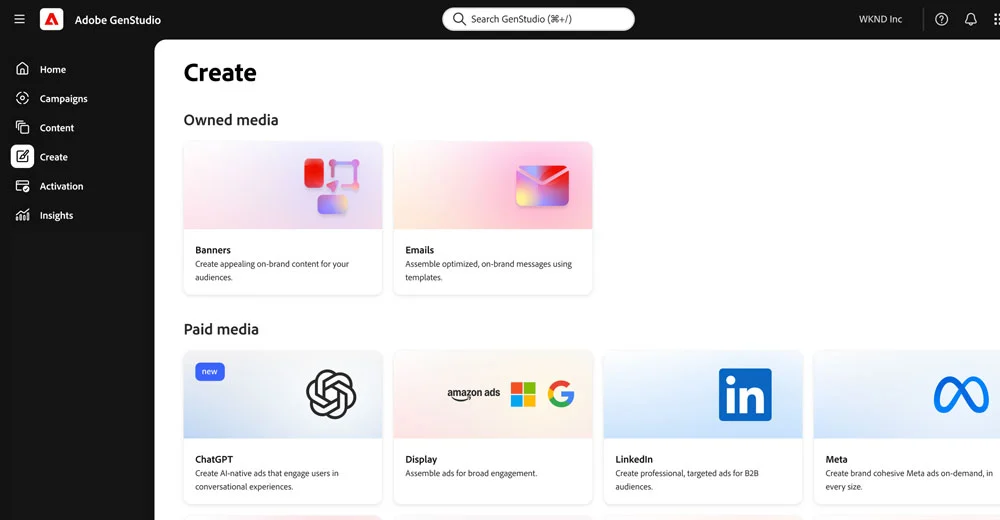
Adobe’s answer to this challenge is Brand Intelligence and the expanded GenStudio content supply chain story. Brand Intelligence is designed to move companies past static brand books into a living system that learns from approvals, rejections, annotations, and review cycle feedback.
In practical terms, Adobe wants to transform brand governance from a PDF document that no one reads into machine readable context that AI agents can actually use and apply. This is one of the more practical and grounded ideas to come out of the summit. Enterprise AI initiatives tend to fall apart quickly when every output still has to be manually corrected and approved by brand teams.
Varun Parmar, GM of Adobe GenStudio and Firefly for Enterprise, made the case clearly. He noted that the campaign process has long been “hampered by inefficient processes and broken workflows.” Adobe is attempting to fix this by unifying “brand intelligence, agentic automation and AI powered workflows.”
This messaging sounds like classic enterprise positioning, but in this case it addresses a genuine pain point. Most marketing organizations do not have an AI problem. They have a workflow problem disguised as an AI problem. The tools exist. The challenge is connecting them in ways that actually improve productivity rather than creating additional complexity.
Trust, Governance, and Commercial Safety
Another important part of this theme is trust. Adobe repeatedly emphasized governance, accountability, context, and commercial safety throughout the summit. This emphasis was not accidental.
In an enterprise environment, the fastest AI model does not automatically win. The model or workflow that keeps legal, brand, and compliance teams from experiencing operational meltdowns has a very strong chance of succeeding. Adobe recognizes that enterprises need confidence that their AI systems will operate within defined parameters and deliver predictable results.
This focus on trust reflects Adobe’s understanding of its enterprise customer base. These organizations have rigorous compliance requirements, legal obligations, and brand standards that cannot be compromised. Any AI system that ignores these constraints will quickly be rejected regardless of its technical capabilities.
Open Ecosystems and Real Workflows
A fourth theme was openness and ecosystem pragmatism. Adobe does not expect to win by forcing customers into a closed, proprietary system. Instead, the company stressed interoperability as a core value.
Adobe CX Enterprise spans Adobe and partner environments, with expanded partnerships that include AWS, Anthropic, Google Cloud, IBM, Microsoft, Nvidia, OpenAI, major advertising agencies, and systems integrators. This broad partnership ecosystem reflects Adobe’s recognition that no single vendor can provide everything an enterprise needs.
Adobe VP of Ecosystem Development, Amit Ahuja, noted that marketers should not have to choose between enterprise AI tools and marketing outcomes. Adobe intends to bridge this gap with integrations and workflow extensibility that allow customers to use best in class tools while maintaining a coherent overall system.
This is where Adobe looked disciplined rather than defensive. The market has changed fundamentally. No large enterprise is going to run on a single model, agent framework, workflow tool, or data environment. Adobe appears to understand that the real prize is becoming the layer that gives these moving parts commercial context, governance, and measurable output.
Nvidia CEO Jensen Huang reinforced this worldview from a different angle when he said, “The user interface of the future, all the front end of SaaS, is now agentic.” This comment landed effectively because it supports Adobe’s broader argument that the interface is changing, but enterprises still need trusted systems underneath it to provide stability and governance.
AI Discovery and Brand Visibility
Another important angle at the summit was the rise of AI mediated discovery and the growing importance of brand visibility inside LLM driven environments. This may have been one of the most interesting parts of the keynote because it pushes beyond internal productivity into go to market risk.
Chakravarthy noted that LLMs and AI platforms are becoming a primary interface between customers and brands. He cited Adobe’s data showing that AI driven traffic to U.S. online sites rose 269 percent year over year in March. This represents a fundamental shift in how customers discover products and services.
Chakravarthy also highlighted that 80 percent of businesses have significant gaps in how their brands appear on AI platforms. This is a serious warning shot for the industry. Search and discovery are changing, and paid media strategies will inevitably follow.
Adobe’s response to this challenge includes Brand Concierge, supply chain changes for conversational surfaces, and support for ChatGPT Ads in GenStudio for Performance Marketing. Adobe isn’t just watching new interfaces emerge. The company is actively integrating the advertising and content stack to help brands maintain visibility in AI mediated environments.
This focus on AI discovery reflects Adobe’s understanding that the customer journey is evolving rapidly. Brands that fail to appear in AI recommendations will lose customers to competitors who have optimized for this new reality. Adobe is positioning itself to help brands navigate this transition.
The Enterprise Reality Check
There was also a current of enterprise caution running through the summit, providing a healthy counterbalance to the excitement. Adobe’s own AI and Digital Trends report tempered any sense of triumphalism with sobering data about the current state of enterprise AI adoption.
The report found that while organizations are seeing early wins from generative AI, many still lack the foundations necessary to scale agentic AI effectively. Data remains fragmented across organizational silos. Alignment between business units is uneven. Enterprise wide deployment of AI capabilities remains rare.
Fewer than half of organizations say their data quality is adequate for AI initiatives. Only 39 percent have a shared customer data platform capable of supporting agentic AI applications. This is the inconvenient truth behind the keynote excitement and the ambitious product announcements.
Customers are equally unforgiving. Adobe’s report indicates that 50 percent of customers give promotional content only two to five seconds of attention. Half disengage if promotions are irrelevant or mistimed. AI can scale personalization dramatically. But poor data quality and fragmented workflows make AI accelerate failure rather than success.
This tension may be the most important takeaway from Adobe Summit 2026. The vision is ambitious and, in many ways, compelling. But the execution challenges are equally significant. Adobe must help customers navigate the gap between what’s technically possible and what’s organizationally achievable.
The Gap Between Vision and Execution
The gap between vision and execution may be the most important takeaway from the entire event. Adobe’s vision is genuinely ambitious and compelling. The company is making a serious play to own the connective tissue between creative generation, brand governance, data driven decisioning, and agentic execution.
Adobe is also making the right enterprise argument that trust, governance, and interoperability matter just as much as raw model horsepower. This positions the company favorably against competitors who may focus more on technical capabilities than on the practical realities of enterprise deployment.
Narayen’s statement that “tools don’t create, people do” effectively kept Adobe’s human centered philosophy intact even as the company leans harder into automation. This is an important rhetorical position because it addresses concerns that AI might replace rather than augment human creativity.
The Skepticism Is Fair
However, let’s not be naive about the challenges ahead. Adobe is making this strategic push at a moment when investors, customers, and competitors are all asking tougher questions. The company must prove that its AI agent offerings can help it stay ahead of AI native disruption from both established competitors and emerging startups.
The skepticism is fair and warranted. Adobe’s strategy is more coherent than ever before, but coherence is not the same thing as widespread adoption. Enterprises still have to operationalize all of this. They have to integrate these capabilities into existing workflows, train their teams to use them effectively, and measure the actual business outcomes.
The partnership ecosystem approach helps address some of these challenges by providing integration with existing tools and systems. But the fundamental challenge of organizational change management remains. AI adoption is as much about people and processes as it is about technology.
The Bottom Line
Adobe Summit 2026 was not about showy AI tricks or flashy demonstrations. It was about Adobe defining the enterprise playbook for the next phase of digital experience and customer engagement. The company is betting that the winners in this new era won’t be those with the loudest demos or the most advanced models.
Instead, Adobe believes the winners will be those who can turn creativity, data, governance, and agentic workflows into something scalable, practical, and genuinely useful for enterprise customers. This is the right bet, and Adobe’s strategy is more coherent than ever before.
However, coherence is not the same as execution. Adobe must now prove it can deliver on this ambitious vision in ways that generate measurable business value for its customers. The company has laid out a compelling roadmap. The next step is demonstrating that it can actually execute on it.
The enterprise AI market is at an inflection point. The early excitement and experimentation are giving way to more serious considerations about scale, governance, and business outcomes. Adobe is well positioned to serve this maturing market, but the competition is intense and the stakes are high.
For customers evaluating Adobe’s offerings, the message from Summit 2026 is clear. Adobe wants to be the control layer that connects all the moving parts of the enterprise customer experience ecosystem. The vision is ambitious, the strategy is coherent, and the execution remains the critical question mark that will determine success or failure.
TechTrib.com is a leading technology news platform providing comprehensive coverage and analysis of tech news, cybersecurity, artificial intelligence, and emerging technology. Visit techtrib.com.
Contact Information: Email: [email protected] or for adverts placement [email protected]
About The Author
