

The New Frontier: Google’s AI Elite Embark on a Bold Scientific Mission
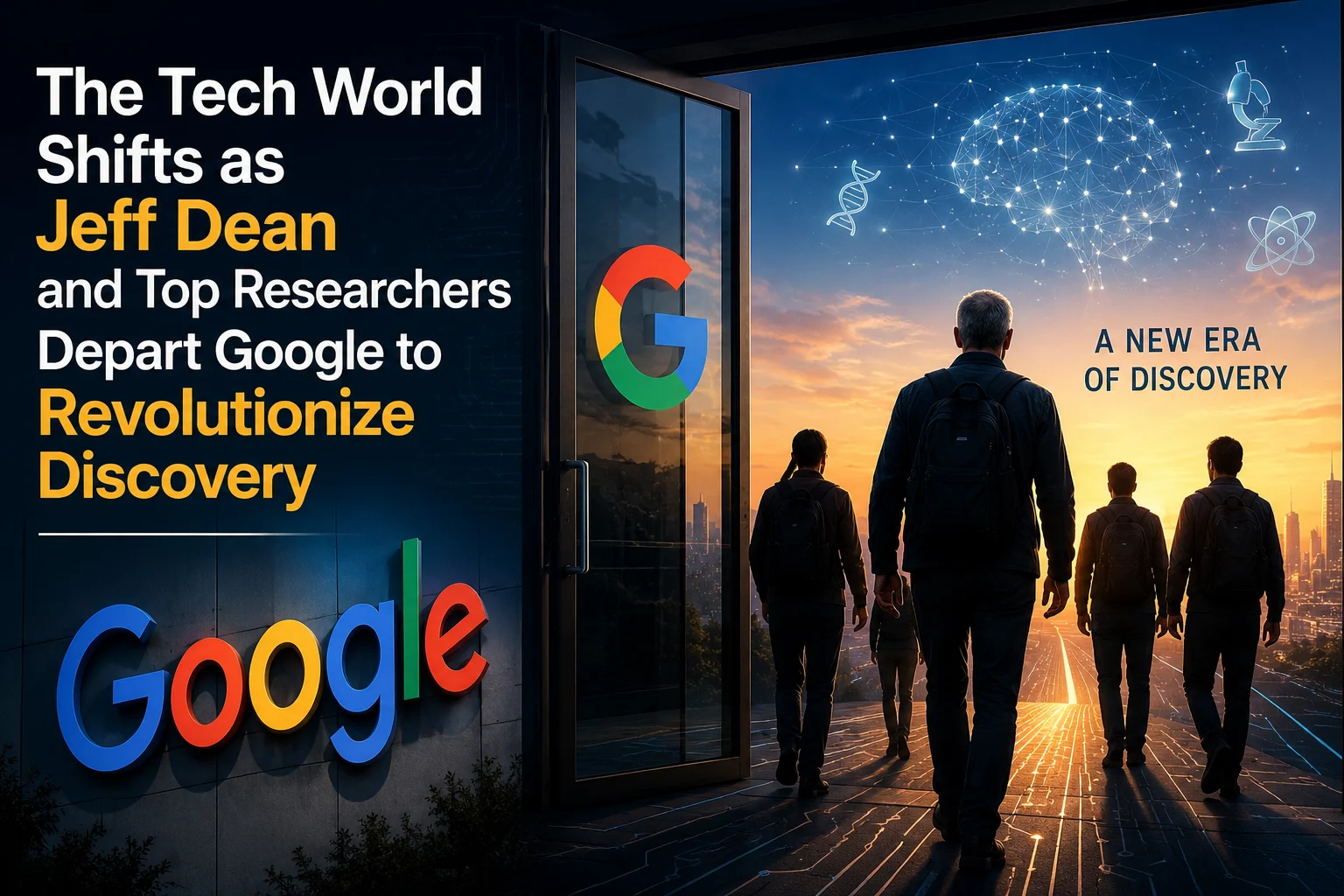
The Tech World Shifts as Jeff Dean and Top Researchers Depart Google to Revolutionize Discovery
In a seismic move that sent ripples through the technology sector, Jeff Dean, one of the most distinguished and longest serving executives at Google, has announced his departure from the search giant. He is not leaving alone. A constellation of Google’s most brilliant artificial intelligence researchers are joining him to launch a new venture that could fundamentally reshape the landscape of scientific research.
The Dream Team Behind Discovery Loop
Dean, who joined Google in 1999 as the company’s 30th employee, has been a towering figure in the development of Google’s core infrastructure, including its crawling, indexing, and query serving systems. His influence extended far beyond search, playing a pivotal role in the development of Google Gemini’s multimodal models and leading the company’s early AI research.
He is bringing with him a cohort of equally impressive talent. Sanjay Ghemawat, a top engineer and senior fellow at Google, will join as a cofounder. Quoc Le, a key AI researcher and a founding member of Google Brain, is also making the leap, along with Oriol Vinyals, a senior research scientist at Google DeepMind. Together, they are forming a formidable team that combines decades of experience in pushing the boundaries of artificial intelligence.
The Mission: Automating the Scientific Method
The new company, named Discovery Loop, is not merely another AI startup focused on chatbots or image generation. It is established as a public benefit corporation with a specific and ambitious goal: to use artificial intelligence to turbocharge scientific research. The company aims to fundamentally transform the speed and efficiency of innovation by automating complete experimental loops.
Discovery Loop plans to deploy high performance algorithms that can initiate and iterate thousands of experiments simultaneously. This approach seeks to partially automate the research process, expanding the scale at which experimentation can be conducted far beyond human capability. The ultimate vision is to create a system that can run experiments, analyze results, and formulate new hypotheses with minimal human intervention.
The Pursuit of Recursive Self Improvement
One of the most ambitious and intriguing aspects of Discovery Loop’s plan involves the concept of recursive self improvement. The startup is interested in using AI to help create more powerful AI, a process that could effectively cut human iteration out of the development loop entirely. This approach, where an AI system helps design and train its successor, represents a potential shortcut to developing vastly more capable AI models.
The company’s founding team articulated their vision in a joint statement, saying, “The next great frontier for AI is to go beyond answering questions and to begin making discoveries. By fundamentally accelerating how engineering and scientific discovery are conducted, we can deliver the benefits of transformative technologies to the world far sooner.” Jeff Dean further elaborated to the New York Times, stating, “We think there is opportunity for AI to more fully automate what has traditionally been a very human intensive experimental loop. You will get both a higher quantity and a higher quality of experiments, and that will lead to scientific breakthroughs and advances.”
Financial Backing from a Who’s Who of Venture Capital
The startup has already secured significant financial support from a diverse group of investors, including an unexpected backer. Google’s parent company, Alphabet, is among the financial supporters. The initial funding round is being co-led by Radical Ventures and Khosla Ventures. Other participants include prominent firms such as Kleiner Perkins, Lightspeed, and Doerr Capital. This robust financial backing signals strong confidence in the team and their ambitious mission.
A Departure and an Endorsement
The departure of these top researchers represents a significant shift for Google, which has long been considered a leader in artificial intelligence research. The loss of such a deep bench of talent is undeniable. However, Alphabet’s decision to invest in the spinout suggests a strategic belief that the new venture can achieve goals that may have been harder to pursue within a larger corporate structure.
Discovery Loop’s focus on scientific discovery is a response to a longstanding interest in the science and tech communities. While using AI to accelerate scientific discovery has been a key area of exploration for many years, it remained a largely experimental field with limited commercial application until now. This new company, led by one of the most respected names in the industry, aims to change that, turning a long held vision into a commercial reality.
Drop a comment below or reach out on the socials.
TechTrib.com is a leading technology news platform providing comprehensive coverage and analysis of tech news, cybersecurity, artificial intelligence, and emerging technology. Visit techtrib.com.
Contact Information: Email: [email protected] or for adverts placement [email protected]
About The Author
