

The Unlikely Alliance: How Fusion Power Found Its Way Back to Defense
Category: Energy Innovation / Defense Technology
There is a certain irony in the story of fusion power. The technology that promises limitless clean energy for humanity was born from the darkest impulse of the twentieth century: the thermonuclear bomb.
Now, decades later, that irony is deepening. As venture capital for climate tech stalls and the path to commercial fusion remains frustratingly long, fusion startups are rediscovering their roots. They are turning back to the defense industry, not as a moral compromise, but as a strategic necessity.
This is not a retreat from their ultimate goal of putting clean electrons on the grid. It is a pragmatic recognition that the road to fusion power may run through the Pentagon.
The Funding Crunch That Changed Everything
The shift did not happen in a vacuum. It was driven by hard economics.
Venture dollars committed to climate tech have stalled. Fusion startups, despite capturing a large portion of recent climate tech funding, are expensive ventures. Building a fusion reactor requires massive capital, years of research, and an almost unreasonable tolerance for risk. Venture capitalists are patient, but they are not infinitely patient.
When the funding environment tightens, startups must find alternative sources of revenue. The defense industry, with its deep pockets and appetite for cutting edge technology, has become an obvious partner.
But this is not merely a financial transaction. It is a return to first principles. The sector emerged decades ago when physicists sought more constructive uses for the science behind thermonuclear weapons. The national security angle never truly disappeared. The groundbreaking fusion experiment at the National Ignition Facility in 2022 took place at a site that has supported national security applications for more than 25 years.
The connection was always there. It just needed a catalyst to reemerge.
The Drone Problem and the Laser Solution
That catalyst has arrived in the form of drones.
Modern warfare has been reshaped by unmanned aerial vehicles. Traditional air defense systems were designed to target human piloted aircraft, which tend to be larger and fewer in number. Drones are small, cheap, and numerous. This has created a series of increasingly absurd mismatches between attacker and defender.
Consider this: about a decade ago, a U.S. ally used a $3 million Patriot missile to shoot down a $200 consumer drone. The missile worked. The economics did not.
Laser weapons promise to alter this math entirely. Instead of firing a single, expensive, one use missile per shot, lasers fire quickly and relatively cheaply. They draw electricity from a generator, a ship’s reactor, or an engine. The cost per shot is measured in dollars, not millions.
This is where fusion startups become relevant. Companies working on laser based fusion reactor designs have developed precisely the kind of high powered laser systems that could power next generation directed energy weapons.
Xcimer and RTX: A Blueprint for the New Alliance
Last week, laser based fusion startup Xcimer announced a partnership with and investment from RTX, the conglomerate that includes defense contractor Raytheon. Under the deal, Xcimer receives funding from RTX Ventures, while RTX gains the ability to explore how to use Xcimer’s powerful lasers for its own purposes.
This is not a charity arrangement. It is a strategic exchange.
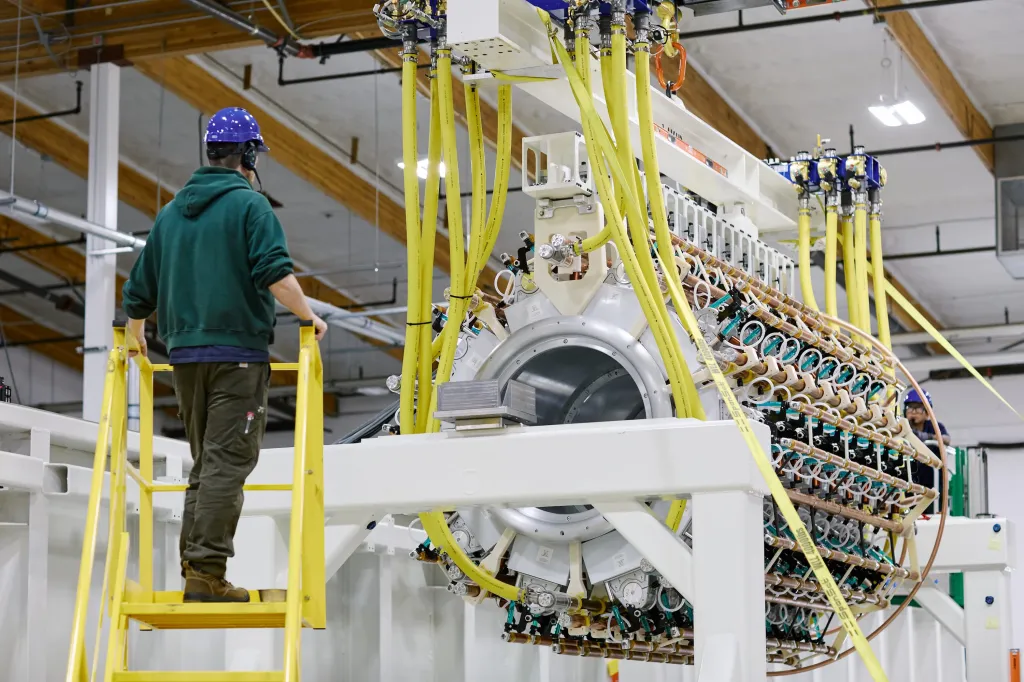
Denver based Xcimer currently operates what it claims is the largest privately owned laser system in the world. The company plans to use this system to develop a fusion power plant. Inside that plant, lasers will bombard fuel targets, compressing them until atoms fuse and release energy.
The current laser system, named Phoenix, operates at an order of magnitude lower power than will be required for a commercial power plant. But it is already powerful enough to catch the attention of the defense industry.
The logic is elegant. The same lasers that could one day ignite a star on Earth can also be used to shoot down drones, disable sensors, or intercept missiles. The research and development path for one application directly benefits the other.
Pacific Fusion and the Nuclear Security Connection
Xcimer is not alone in this strategic pivot.
Pacific Fusion announced a memorandum of understanding last month with the National Nuclear Security Administration to work together on high energy density fusion experiments. The startup recently broke ground on a demonstration facility in New Mexico, not far from the Sandia and Los Alamos National Laboratories.
The primary purpose of this facility is to demonstrate that Pacific Fusion’s design can generate more power than it consumes. But it has other uses. The fusion reactions at Pacific Fusion’s facility will be far more powerful than those the government currently uses to perform nuclear weapons experiments.
Keith LeChein, co-founder and chief technical officer at Pacific Fusion, told TechCrunch that the facility they are building “also has utility in this world leading defense application.”
This might sound like a convenient coincidence. It is not. Defense applications were “always on our mind,” according to Carrie von Muench, co-founder and chief operating officer at Pacific Fusion.
The connections run deep. LeChein, who developed the company’s core technology, previously worked at Sandia National Laboratories, Lawrence Livermore National Laboratory, and the National Nuclear Security Administration. This is not a company that stumbled into defense work. It was built by people who understand the national security ecosystem intimately.
The Strategic Implications
The reacquaintance between fusion power and national security has profound implications for both industries.
For Fusion Startups:
The defense industry offers a lifeline. In a funding environment where climate tech venture capital has stalled, defense contracts provide stable, long term revenue. They also offer something perhaps more valuable: a near term application that can sustain the company while the long term goal of grid scale power remains years away.
This is not a sellout. It is a survival strategy. A fusion company that goes bankrupt before achieving its goal helps no one.
For the Defense Industry:
Laser weapons have been a promise for decades, but the technology has often lagged behind the hype. Fusion startups bring fresh approaches, private sector agility, and a deep understanding of high energy physics. The partnership gives defense contractors access to cutting edge research without bearing the full cost of development.
For the Energy Transition:
There is a risk here. If fusion startups become too dependent on defense funding, they may lose focus on their original mission. The ultimate goal of limitless clean energy could be subordinated to the immediate demands of weapons development.
But there is also an opportunity. The technical challenges of fusion power and directed energy weapons overlap significantly. Advances in one field accelerate progress in the other. The defense industry may end up funding the research that finally makes commercial fusion viable.
The Historical Echo
There is a historical echo here that is worth noting. The original fusion researchers were weapons scientists. They had seen the destructive power of the technology they helped create and sought to redirect it toward peaceful purposes.
Now, the grandchildren of that generation are reversing the flow. They are taking technology developed for peaceful energy production and adapting it for defense.
Is this a betrayal of the original vision? Or is it a recognition that the line between peaceful and military applications of technology has never been as clear as we would like to believe?
The answer may depend on perspective. For a startup struggling to survive, a defense contract is not a moral compromise. It is a pragmatic necessity. For a defense contractor facing new threats, a fusion startup is not a weapons manufacturer. It is a source of innovation.
The Verdict: An Overdue Reunion
Fusion power has come a long way since the first weapons scientists dreamt it up decades ago. But its national security applications have not been forgotten. Their recent reacquaintance is perhaps overdue.
The partnership between fusion startups and the defense industry is not without risks. It could divert resources from the ultimate goal of clean energy. It could entangle startups in ethical dilemmas they are not prepared to navigate. It could create dependencies that are difficult to break.
But it also offers a path forward. In a world where climate tech funding is uncertain and the timeline for commercial fusion remains frustratingly long, defense partnerships provide a bridge. They keep the lights on. They keep the research moving. They keep the dream alive.
The challenge for fusion startups will be to walk this line carefully. They must take defense money without becoming defense companies. They must develop weapons technology without losing sight of their founding mission. They must survive long enough to deliver on their promise.
It is a difficult balance. But for an industry that has always thrived on seemingly impossible challenges, it may be the most important one yet.
TechTrib.com is a leading technology news platform providing comprehensive coverage and analysis of tech news, cybersecurity, artificial intelligence, and emerging technology. Visit techtrib.com.
Contact Information: Email: news@techtrib.com or for adverts placement adverts@techtrib.com
About The Author
