

The Hidden Cost of AI: U.S. Data Centers Could Outpace Entire Nations in Natural Gas Consumption by 2035
The artificial intelligence boom has a voracious appetite. Every chatbot conversation, every generated image, and every model training run demands enormous amounts of computing power, and that power has to come from somewhere. According to a new report from BloombergNEF, the consequences of that demand are staggering: by 2035, U.S. data centers are projected to consume more natural gas than Germany and Japan combined.
Let that sink in for a moment. Two of the world’s largest industrialized economies, with a combined population of roughly 210 million people, would use less natural gas than the server farms powering America’s AI ambitions.
A Forecast That Keeps Growing
The numbers are striking on their own, but the trajectory is what makes them truly alarming. Data centers are expected to become the second strongest driver of natural gas demand growth over the next decade, trailing only LNG exports. The facilities could consume about 18 billion cubic feet per day by 2035, according to BloombergNEF.
That figure is nearly double what the organization predicted just nine months ago. The rapid revision reflects the frenzied pace of AI infrastructure investment, as companies race to build ever larger clusters of GPUs and the power infrastructure to support them. The new forecast does take into account that not all announced data center projects will be completed, a sobering acknowledgment that even the most aggressive projections may not capture the full picture.
Onsite Power: A Growing but Partial Solution
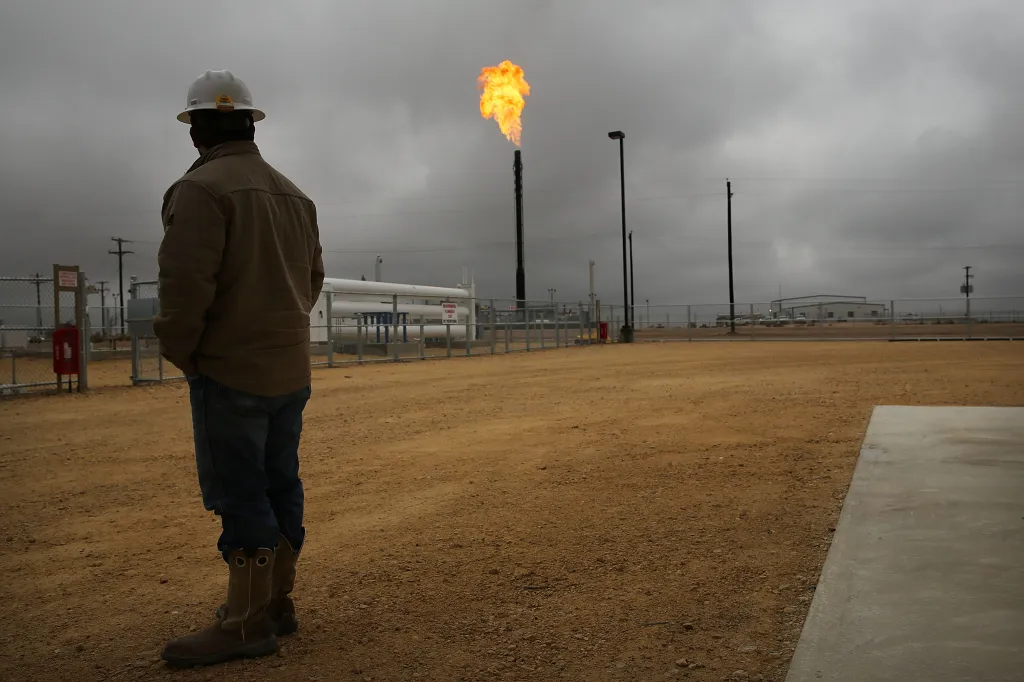
One response to the grid’s limitations has been for tech companies to build their own power plants. Meta, Microsoft, Google, and Amazon have all announced plans for new natural gas power plants that will bypass the grid entirely, generating electricity onsite to feed their data centers.
These projects have grabbed headlines, and for good reason. According to BloombergNEF, onsite powered data centers will consume 2.9 billion to 3.4 billion cubic feet per day by 2035. That is roughly as much as all data centers consume today, including natural gas used to generate power for the grid.
Yet despite the attention these projects receive, they represent just a fraction of overall demand growth. The bigger story is the grid itself. By the middle of the next decade, grid connected data centers are predicted to drive an additional 15 billion cubic feet per day of natural gas consumption by the power sector. To put that in context, that is five times more demand growth through 2035 than from all other grid connected sectors combined.
The Price Tag Nobody Wants to Talk About
Much of today’s data center buildout relies on stable natural gas prices, which have prevailed in recent years. But analysts at Noreva think that might be a false hope. The combined impact of the data center boom and rising LNG exports could cause prices to soar.
This raises an uncomfortable question. Even if tech companies’ balance sheets can bear such a surge, utility ratepayers might not be able to. There is a real risk that the cost of powering the AI revolution gets passed on to ordinary households and small businesses that had nothing to do with creating the demand. It is a classic case of privatized benefit and socialized cost, and it could become a political flashpoint in the years ahead.
The Climate Cost
Then there is the climate impact, which is difficult to overstate. Burning one cubic foot of natural gas releases the equivalent of 60 grams of carbon dioxide into the atmosphere, including extraction, processing, and distribution, according to the International Energy Agency.
The additional demand from data centers will generate 1 million metric tons more greenhouse gas pollution daily. That is about 12% of total U.S. greenhouse gas emissions today, added on top of everything else the country already emits. To frame it another way, the AI boom alone could add the equivalent of a mid sized nation’s annual emissions to the atmosphere every single day.
This is a deeply uncomfortable reality for an industry that has often positioned itself as part of the solution to climate change. Many of the same companies building these gas hungry data centers have made ambitious pledges to reach net zero emissions. The math is becoming increasingly difficult to reconcile.
The Renewables Gap
One might ask why data centers are not simply powered by renewable energy. The answer is complicated. Solar and wind are intermittent, and data centers require constant, reliable power. Battery storage has improved dramatically but remains expensive at the scale required for a massive AI cluster.
Nuclear power, meanwhile, offers carbon free baseload generation but takes years to build and faces regulatory hurdles. Small modular reactors are promising but not yet commercially deployed at scale. In the near term, natural gas is the path of least resistance, which is precisely why so many companies are turning to it despite their climate commitments.
What This Means for the Energy Transition
The data center boom is forcing a reckoning with the pace of the energy transition. For years, the narrative was one of steady progress toward renewables, with natural gas serving as a bridge fuel that would eventually be phased out. That bridge is now being widened and reinforced, not dismantled.
If the BloombergNEF forecast holds, natural gas infrastructure built to serve data centers will lock in decades of emissions. Power plants have operational lifespans measured in decades, and the companies building them have every incentive to keep them running. The result could be a significant delay in the transition to clean energy, precisely at the moment when scientists say emissions need to fall rapidly.
Conclusion
The AI race has produced remarkable advances and enormous economic value, but it has also created a demand for energy that the current system is ill prepared to meet cleanly. The projection that U.S. data centers could consume more natural gas than Germany and Japan combined by 2035 is not merely a statistic. It is a warning. It warns of rising energy prices that could burden ordinary ratepayers. It warns of a climate impact that could undermine corporate sustainability pledges. And it warns that the infrastructure being built today will shape the emissions trajectory of tomorrow. The companies driving the AI boom have the resources and the ingenuity to power their data centers more cleanly. The question is whether they will choose to do so before the lock in becomes irreversible. The forecast is a reminder that the cost of intelligence, in energy and emissions, is real and growing. The industry would do well to confront that reality now, before it becomes impossible to ignore.
TechTrib.com is a leading technology news platform providing comprehensive coverage and analysis of tech news, cybersecurity, artificial intelligence, and emerging technology. Visit techtrib.com.
Contact Information: Email: news@techtrib.com or for adverts placement adverts@techtrib.com
About The Author
