

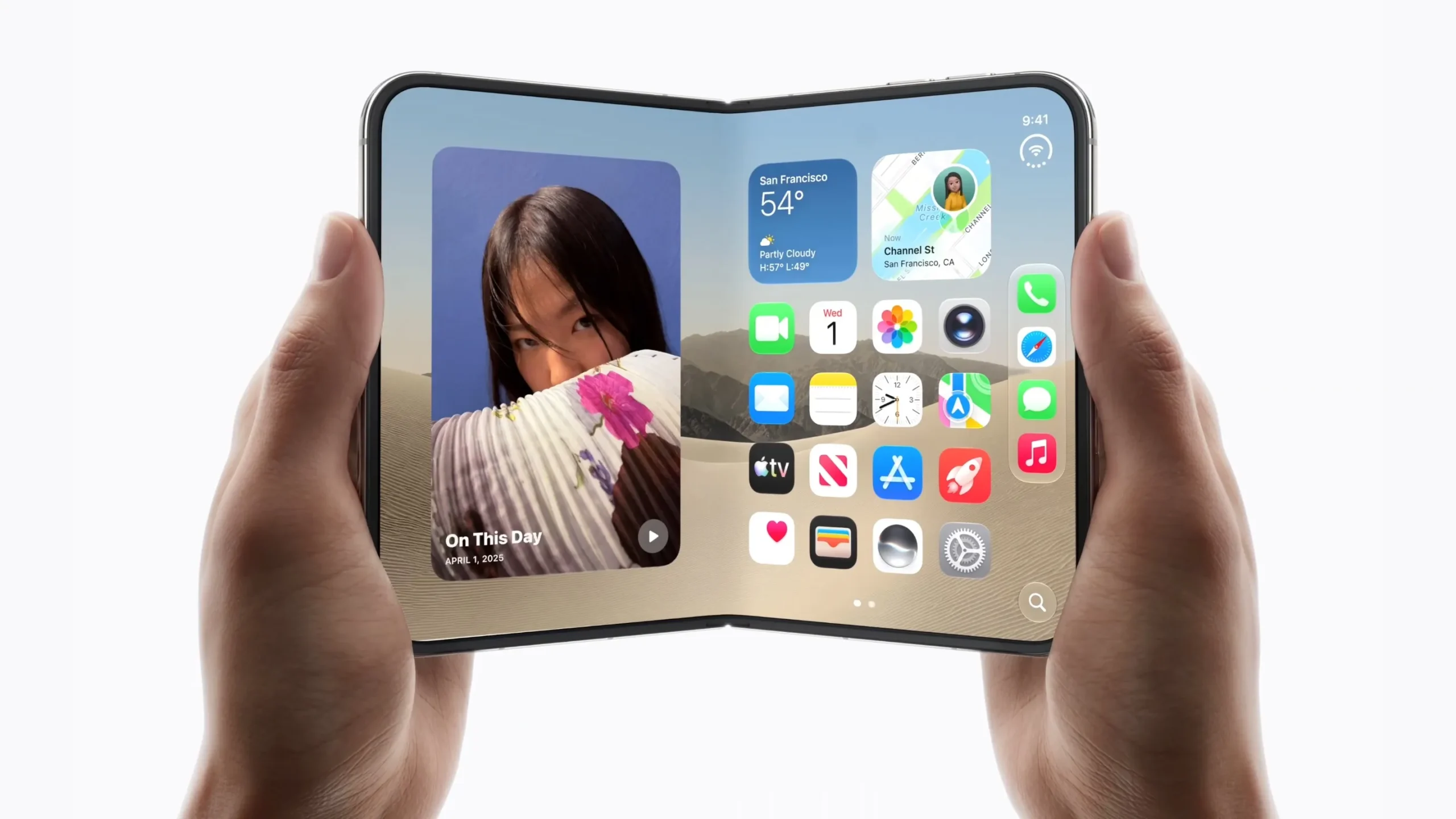
The Duo Era Begins: Apple Finally Enters the Foldable Arena
Date: September 14, 2026
Category: Consumer Technology / Product Analysis
For years, the tech world has been asking the same question: When will Apple release a foldable iPhone?
The answer has finally arrived. At its Surprise and Shine event in Cupertino, Apple unveiled the iPhone Duo, its first foldable device. And in true Apple fashion, the company did not simply copy what came before. It studied the category, identified its weaknesses, and engineered something that feels distinctly its own.
This is not just another product launch. It is a statement of intent. It is the first marquee device launched under new CEO John Ternus. And it signals that Apple, long criticized for trailing competitors in hardware innovation, is ready to lead again.
The Form Factor: Wide, Not Tall
The most striking thing about the iPhone Duo is its shape.
Early foldables from Samsung and others were vertical slabs. They folded like a book, opening into a tall, narrow display. The iPhone Duo takes a different approach. Apple adopted a wider form factor that aids in a better aspect ratio while watching videos when the device is unfolded.
This is a subtle but significant design decision. When you unfold a tall, narrow phone, you get a display that is awkward for video content. There are black bars on the sides. The experience feels compromised. By choosing a wider form factor, Apple has created a device that unfolds into something closer to a tablet, a surface that is genuinely better for media consumption.
The unfolded display is a 7.6 inch Retina display. The outer display is 5.4 inches. Apple said the device was “inspired by the versatility of iPad,” and that is evident in how the company envisions its use. You can use it unfolded in vertical mode. You can split apps. You can pin a video on top while using other apps on the bottom half.
The inner display features an under display camera, giving users an all screen feel. This is a feature that competitors have been slow to adopt, and it represents a genuine step forward in design.
The Crease Problem: Solved?
One of the most persistent criticisms of foldables is the crease. That visible line down the middle of the display where the phone folds. It is a constant reminder that you are using a compromised device, a piece of technology that has not quite been perfected.
Apple claims to have addressed this with a custom nanotexture finish that hides the crease and reduces glare. The company said its hinge was created using grade 5 aluminum and over 100 special components for smooth opening and closing and durability.
Most foldables still have a visible crease. Companies like Oppo have made strides toward an almost seamless phone. But no one has fully eliminated it. If Apple has genuinely solved this problem, it would be a significant competitive advantage.
The question, of course, is whether the nanotexture finish actually works. Marketing claims are one thing. Real world experience is another. Only time and hands on reviews will tell.
The Trade Offs: What Apple Left Out
No device is perfect, and the iPhone Duo makes some notable compromises.
The most striking omission is Face ID. The device only has Touch ID. This is a significant departure from Apple’s recent flagship phones, which have relied on facial recognition for years. The reason is likely technical. The foldable design makes it difficult to fit the complex sensor array required for Face ID. Apple has compensated by allowing users to unlock the device using the Apple Watch, but this is a workaround, not a solution.
The device is powered by the new A20 Pro chip and C2 model, which allows for faster uploads. Just like last year’s iPhone Air, this particular model is eSIM only. This is part of Apple’s broader push toward a completely portless future, but it may frustrate users who prefer physical SIM cards.
On the battery front, the company said that with the inner display, users can get 31 hours of video playback. With the outer display, that number rises to 44 hours. This is impressive for a foldable, which typically struggles with battery life due to the larger display and complex hinge mechanism.
The Camera System: A Deliberate Choice
The iPhone Duo features a 48 megapixel fusion main camera and a 48 megapixel ultrawide camera with 2x optical zoom. Notably, this dual camera setup skips a telephoto camera.
This is a deliberate choice. Telephoto lenses are bulky, and in a foldable device, space is at a premium. Apple has prioritized the main and ultrawide cameras, which are the ones most people use most often.
The device also includes some clever software features. Just like other foldables, users can take rear camera selfies and look at previews on the outer display. There is also a Google Pixel like feature that plays an animation on the outer display, useful when you are trying to get kids to focus while taking photos. And there is a smart take feature that uses an on device model to snap an image when all subjects within the frame are posing.
These are the kinds of thoughtful, user friendly features that Apple is known for. They may not be headline grabbers, but they make the device more pleasant to use.
The Software: iOS 27 Adapts
Hardware is only half the story. A foldable device requires software that takes advantage of the larger display. Apple has made iOS 27 adaptable to the new foldable.
Essential controls like Wi Fi move to the side and dock on the home screen in a vertically oriented layout. Users can use apps in split screen and pair apps together. If someone is using the phone vertically, they can pin a video on top and use other apps in the bottom half.
One of the most fascinating features is that users will be able to use the iPhone half folded or even set it on a table. This opens up new use cases, like using the device as a makeshift tripod for video calls or as a display for watching content while eating.
Apple noted that later this year, the device will support Apple Pencil. This is a significant addition. It transforms the iPhone Duo from a phone that folds into a tablet to a genuine productivity device. The lines between iPhone and iPad are blurring.
The Pricing: Premium but Predictable
The iPhone Duo is priced at $1,999 with 256GB storage and comes in two colors. Preorders begin on October 16, and the device will be available on October 23.
This is a premium price. It is significantly more expensive than the base model iPhone 17 or even the iPhone 17 Pro. But it is in line with what competitors charge for their foldables. The Samsung Galaxy Z Fold series, for example, starts at around $1,800.
Apple is not trying to compete on price. It is trying to compete on quality, experience, and ecosystem. Whether that strategy works will depend on whether consumers see enough value in the foldable form factor to justify the premium.
The Competitive Landscape: Late but Not Too Late
Rivals like Samsung and Xiaomi have already launched their versions of wide foldables before Apple. The Galaxy Z Fold has been on the market for years, and it has a loyal following.
But Apple has a history of entering markets late and dominating them. The iPod was not the first MP3 player. The iPhone was not the first smartphone. The Apple Watch was not the first smartwatch. In each case, Apple waited, studied, and then released a product that was better than what came before.
According to analytics firm Counterpoint, foldables contribute to less than 2% of shipments in the overall smartphone market. However, Apple’s new phone could be an instant hit. Counterpoint said the Duo could garner up to 25% market share by the end of the year.
That is a staggering prediction. If it comes true, it would be one of the most successful product launches in Apple’s history.
The Deeper Significance: A New Era for Apple
The iPhone Duo is more than just a product. It is a symbol.
It represents Apple’s willingness to take risks again. Under Tim Cook, Apple was often criticized for being incremental, for prioritizing profits over innovation. The iPhone Duo suggests that under John Ternus, Apple is ready to push boundaries.
It also represents a new chapter in the evolution of the smartphone. For years, the smartphone has been a flat slab of glass. The foldable form factor offers a way to break out of that paradigm. It allows for a device that is both pocketable and expansive, both personal and productive.
Whether the iPhone Duo succeeds or fails, it will be remembered as the moment Apple entered the foldable era. And if the early predictions are correct, it may be remembered as the moment the foldable era truly began.
The Verdict: A Bold First Step
The iPhone Duo is not a perfect device. The lack of Face ID is a notable compromise. The price is high. The foldable form factor is still unproven in the mass market.
But it is a bold first step. It shows that Apple is not content to rest on its laurels. It shows that the company is willing to take risks and push into new territory. And it shows that the iPhone, after nearly two decades, is still evolving.
The foldable era has begun. And Apple, as it has done so many times before, is ready to define it.
TechTrib.com is a leading technology news platform providing comprehensive coverage and analysis of tech news, cybersecurity, artificial intelligence, and emerging technology. Visit techtrib.com.
Contact Information: Email: news@techtrib.com or for adverts placement adverts@techtrib.com
About The Author
