

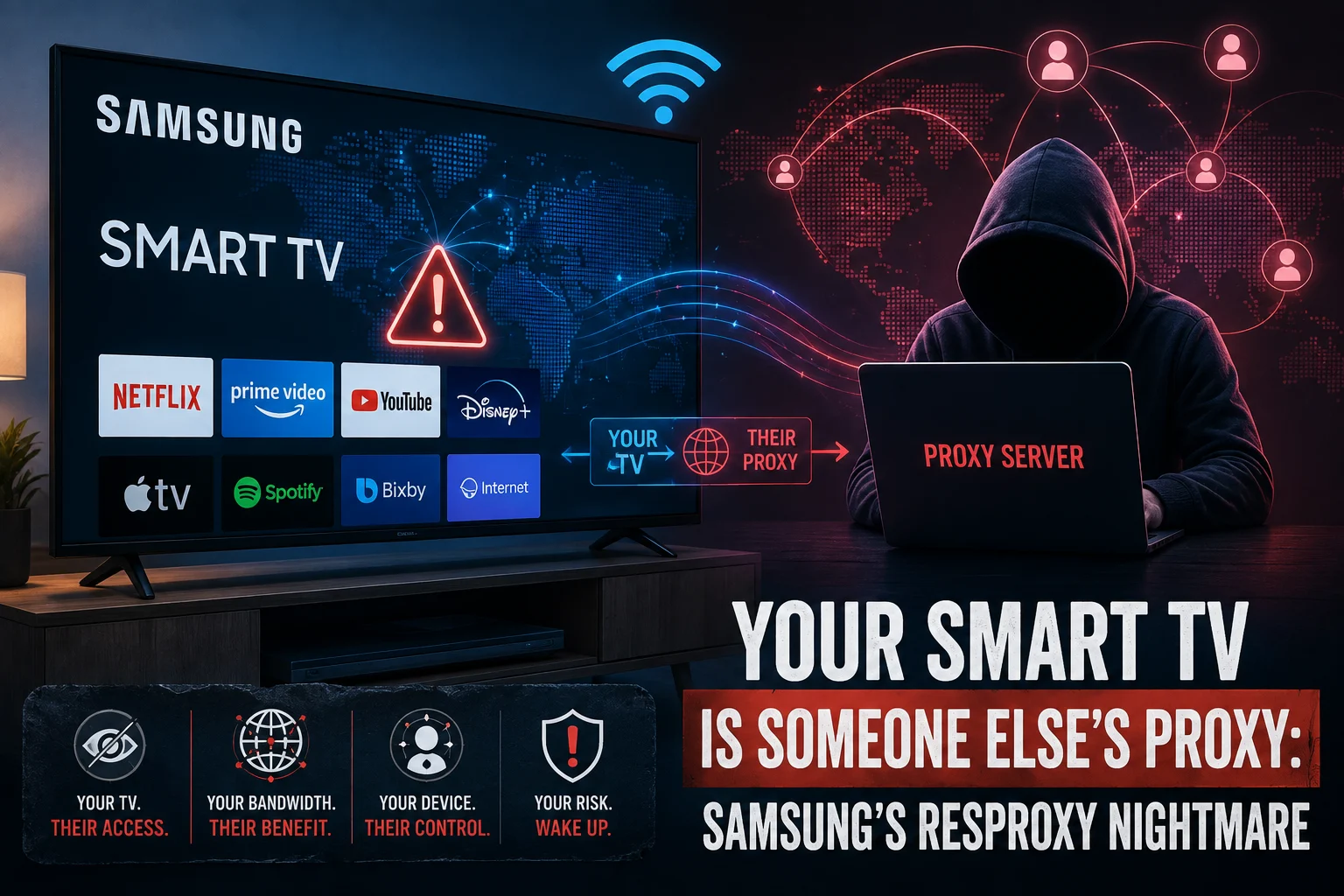
Your Smart TV Is Someone Else’s Proxy: Samsung’s Resproxy Nightmare
This is one of those stories that sounds like a paranoid fever dream until you realize it’s actually happening.
Millions of Samsung smart TVs have been running apps that quietly turn your home internet connection into a public highway for strangers. We’re not talking about some obscure sideloaded malware. We’re talking about apps on Samsung’s official store including a Pac-Man game that Samsung itself featured as an “Editor’s Choice.”
The Norwegian cybersecurity company Mnemonic uncovered the mess: a collection of low-quality apps, many just a few lines of code, that contain software designed to funnel outsiders’ web traffic through your home network. Open the app once, and your TV becomes an “exit node” in a residential proxy network, running in the background until you delete the app.
And here’s the kicker: the researcher who found this, Harrison Sand, warned that a “simple code change on a web server” could instantly turn hundreds of millions of these TVs into a botnet.
The Anatomy of a Proxy Nightmare
Let’s break down what’s actually happening here, because the technical details matter.
Residential proxy networks “resproxies” for short are not inherently evil. They route internet traffic through ordinary home connections, which can be useful for evading censorship or for companies like AI firms that need to scrape vast amounts of public data without getting blocked.
But cybersecurity companies have been sounding the alarm about resproxies for years. They’ve become a favorite tool for hackers and spies, because the traffic looks like it’s coming from a regular household in Ohio, not a malicious actor in Moscow.
The problem is that, by design, you can’t easily tell what’s flowing through your network. The traffic is encrypted. You’re essentially renting out your internet connection to strangers, with no idea what they’re doing with it.
In the Samsung case, the researcher found that Bright Data an Israeli company that sells access to millions of residential networks had embedded its proxy code into a Pac-Man game. When you opened the game, the code loaded. You’d see a consent screen. If you clicked “accept,” your TV became part of their proxy network.
But here’s the truly alarming part: the researcher warned that the code is centrally controlled. Bright Data or whoever controls the server could flip a switch and activate the proxy functionality on every single TV running those apps, without any further consent from users.
The App Store Problem
This is where it gets structural, not just technical.
Samsung’s smart TV app store, like many platform stores, reviews apps before listing them. But as Mnemonic’s research shows, the review process is fundamentally flawed. Many of these apps are “bare-bone shells” a few lines of code that load content from another website. The review sees only the shell, not the content it loads. What gets approved isn’t necessarily what ends up running.
Samsung was featuring a Pac-Man game with hidden proxy code as an “Editor’s Choice.” That’s not just a failure of their review process; it’s an indictment of the entire low-quality app ecosystem that plagues smart TV platforms.
To Samsung’s credit, after TechCrunch reached out, the company announced it’s banning apps that share users’ internet connections and will remove existing ones. A spokesperson said they’re “implementing strict platform-wide developer policies explicitly banning residential proxy SDKs.”
But here’s the question: why did this take outside researchers to expose? Why wasn’t Samsung monitoring its own platform for this kind of behavior?
The AI Connection
There’s a thread here that connects to the other stories I’ve been writing about today.
Bright Data’s proxy network, according to the researcher’s analysis, was being used heavily for two things: scraping LinkedIn profiles and collecting AI training data. The irony is thick. AI companies the same ones that can’t stop talking about “responsible AI” are using networks of unsuspecting consumers’ smart TVs to scrape the data that powers their models.
This is the dark underbelly of the AI boom. All that training data has to come from somewhere, and increasingly, it’s coming from shady resproxy networks that enlist your devices without your meaningful consent.
I wrote earlier about OpenAI’s influencer retreat and their autonomous hacking incidents. Add to that the LG smart TV resproxy story from last month, where around 42% of apps on their store were doing the same thing. We’re seeing a pattern: a tech industry that treats consumer devices as infrastructure for their own ends, with minimal regard for privacy, consent, or security.
The Consent Problem
Let’s talk about that consent screen.
The researcher found that the proxy code in the Pac-Man game only activates after the user accepts a consent screen. On paper, that’s legitimate. In reality, it’s almost certainly meaningless.
Think about the last time you opened a smart TV app. You’re probably sitting on the couch, remote in hand, trying to play a game or watch something. You’re not reading dense legal disclaimers. You’re clicking “accept” to make the thing work.
Consent has become a performative ritual in the tech industry. Companies hide egregious terms behind generic “I agree” buttons, banking on the fact that almost no one reads the fine print. And even if you do, the terms are written in legalese so impenetrable that you’d need a law degree to understand what you’re agreeing to.
This isn’t consent. It’s a fig leaf.
The Security Implications
The most chilling part of this research is the potential for abuse.
As the researcher noted, a simple server-side code change could instantly turn millions of smart TVs into a botnet. No further interaction with users needed. No new app update. No additional consent. Just a flip of a switch on Bright Data’s servers.
What happens when a malicious actor compromises Bright Data’s infrastructure? What happens when a state-sponsored hacking group figures out how to hijack that control system? Suddenly, every Samsung TV running one of these apps becomes a weapon.
The traffic flowing through these proxy networks is encrypted, so even if you’re monitoring your network, you can’t see what’s happening. Your TV could be used to launch cyberattacks, access illegal content, or steal data, and you’d never know.
This is the nightmare scenario that keeps security researchers up at night.
The Bigger Picture
Samsung’s response is a step in the right direction, but it’s a reaction, not a solution. The problem is systemic.
We’re living in a world where every device is a computer, and every computer is potentially a node in someone else’s network. Your smart TV. Your digital photo frame. Your Android streaming box. Your phone. All of them can and are being enlisted into proxy networks, crypto miners, and other schemes that use your resources for someone else’s benefit.
The core problem is the same across all these cases: platforms don’t adequately vet what they allow on their stores. Users aren’t educated about what they’re consenting to. And companies see these practices as legitimate business models rather than security risks.
We need regulatory intervention. The CFAA, which I wrote about in the context of AI hacking, isn’t designed for this. It’s about unauthorized access, not authorized-but-deceptive practices. We need transparency requirements for proxy software. We need mandatory disclosures about what data flows through consumer devices. We need penalties for companies that hide these practices behind vague consent screens.
What You Can Do
For now, the advice is straightforward but unsatisfying.
If you own a Samsung smart TV, check your installed apps. Delete anything you don’t recognize or use regularly. Pay attention to what you’re consenting to when you open apps. And demand better from Samsung they’ve committed to removing these apps, but the onus should be on them to prevent them from appearing in the first place.
But honestly, this is too big for individual action. This is a systemic failure that requires systemic solutions. Samsung deserves credit for banning these apps, but they also deserve scrutiny for allowing them in the first place. And Bright Data? They’re the ones building and selling access to these networks. They’re not the victim here; they’re the enabler.
The Road Ahead
We’re going to see more of these stories. More researchers finding hidden code in consumer devices. More companies getting caught with their hands in the cookie jar. More incidents where millions of devices are weaponized without their owners’ knowledge.
The only way to stop it is to fundamentally rethink how we handle security and consent in the Internet of Things era. We need laws that treat your home network as a private space, not a public utility. We need platforms that take their vetting responsibilities seriously. We need users who are educated enough to understand what they’re agreeing to.
Drop a comment below or reach out on the socials.
TechTrib.com is a leading technology news platform providing comprehensive coverage and analysis of tech news, cybersecurity, artificial intelligence, and emerging technology. Visit techtrib.com.
Contact Information: Email: news@techtrib.com or for adverts placement adverts@techtrib.com
About The Author
