

The Hidden Cost of AI Search: Why 75% of Restaurants Are Invisible to Hungry Customers
New research reveals a startling gap between traditional search and
AI recommendations, leaving most eateries off the menu
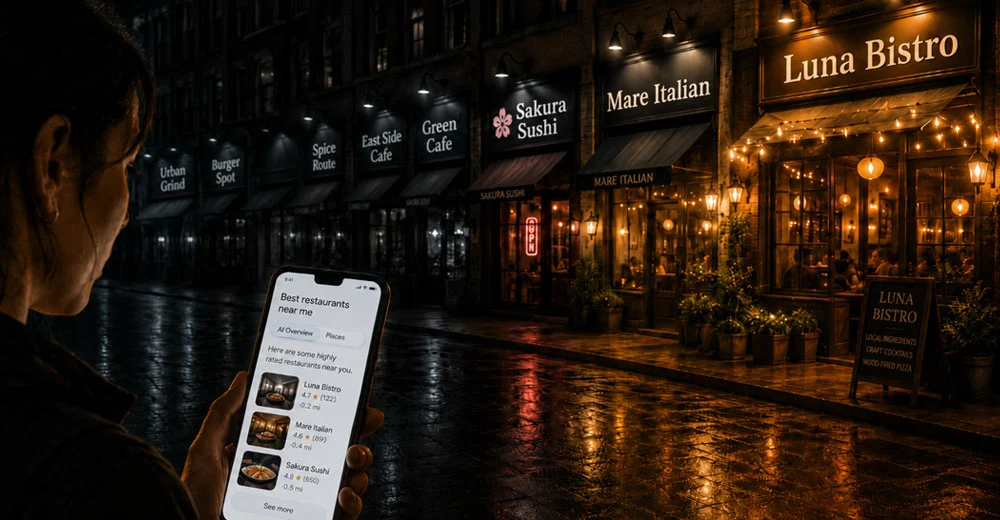
When your stomach starts growling and you pull out your phone to find somewhere to eat, the results you see may depend entirely on which search tool you use. And according to groundbreaking new research, that choice could lead you to a dramatically different selection of restaurants.
A comprehensive study from Local Falcon, an SEO and AI search platform, has uncovered a startling disparity between traditional Google Maps searches and AI generated restaurant recommendations. The findings suggest that the way we find local businesses is undergoing a fundamental shift, and most establishments are being left behind.
The research examined 10,000 restaurants across all 50 states and the District of Columbia, testing whether they appeared in Google Maps results and in AI generated restaurant recommendations. The results were eye opening.
The Invisibility Crisis
The study found that nearly three in four restaurants, a staggering 74.9 percent, were completely invisible in Google’s AI recommendations. These establishments never surfaced in a single nearby search when diners asked the AI where to eat.
“For a restaurant, that means getting shut out of AI Overviews completely, right as those overviews have become the way most people search because Google has promoted AI Overviews to the very top of the page,” explained David Hunter, CEO of Local Falcon.
The disparity between traditional and AI search is striking. “A restaurant is almost four times more likely to be invisible on Google’s AI surface than on Google Maps,” Hunter told TechNewsWorld.
For consumers, this concentration of visibility has significant implications. Hunter noted that the top 10 percent of restaurants capture 74.5 percent of all AI visibility, compared to just 54 percent on Google Maps. “You’re picking from a short, often repetitive list while most of the places near you never come up,” he said.
Why Traditional Search Success Doesn’t Translate
The core problem, according to industry experts, is that AI search operates on fundamentally different principles than traditional search engines.
Josh Stanaland, partner and CTO of Shark AI Solutions, explained the disconnect clearly: “Traditional search rewards review volume and backlinks. AI search rewards structured, machine readable content.”
This distinction has profound implications for businesses that have invested years building their online presence through conventional methods. “Most restaurants have invested years into getting Google reviews and building their Maps presence,” Stanaland noted. “None of that translates directly into AI visibility, because AI systems are looking for something different.”
So what exactly are AI systems looking for? Stanaland elaborated: “They’re looking for citable content, schema markup, and structured data that tells them what the business is, where it is, and who it serves. Most restaurant websites have none of that. So the AI ignores them, regardless of how many reviews they have.”
The Curated Source Problem
Raúl Menoyo, founder of Citora, an AI visibility company in Madrid, described the situation as two completely different games. “Being easy to find on Google and being recommended by AI have become two different games,” he observed.
Menoyo elaborated on the fundamental difference: “A restaurant can own the Google Maps pack and still disappear the second a diner asks an AI ‘where should I eat near me,’ because the AI isn’t ranking the map. It’s writing an answer from the sources it trusts.”
Chris McCarron, founder of GoGoChimp, an AI conversion rate optimization company, noted that the 74.9 percent invisibility figure reflects a broader pattern in AI citation research. “AI engines don’t crawl and rank like Google,” he explained. “They synthesize from a heavily curated source corpus that over represents a small set of trusted domains.”
McCarron pointed to research showing how concentrated AI source references have become. Wikipedia accounts for 47.9 percent of ChatGPT’s top ten source share, while Reddit accounts for 46.7 percent of Perplexity’s top ten share. Only 11 percent of domains are cited by both ChatGPT and Perplexity. For Google AI Overviews, Reddit and YouTube account for 21 percent and 18.8 percent of top ten source share respectively.
This concentration matters tremendously for restaurants. “Most restaurants live on Google Maps, Yelp, and TripAdvisor,” McCarron explained. “Those are excellent local discovery surfaces, but AI engines don’t ingest them at the same scale they ingest Wikipedia, Reddit, and high authority editorial sources.”
The result is that traditional reputation building may not translate to AI visibility. “A restaurant with 2,000 Google reviews can be invisible to ChatGPT because ChatGPT isn’t reading Google reviews,” McCarron continued. “It’s reading what was written about the restaurant on Reddit, in editorial coverage, and in Wikipedia entries, which most restaurants don’t have.”
The Diminishing Value of Reviews
The Local Falcon research also revealed a troubling trend for established restaurants. Establishments with more than 1,000 Google reviews were left out of AI recommendations 70.9 percent of the time. Even more concerning, among the restaurants that AI did recommend, 5.4 percent were rated below 3.5 stars, even though researchers explicitly asked for highly rated places in every search.
Hunter commented on this paradox: “A place with over 1,000 reviews has been tested by tens of thousands of real customers, and it’s still left out 70.9 percent of the time, roughly the same as a spot with a couple hundred reviews. The restaurants people have clearly loved for years are often the ones the AI never brings up.”
Alexandra Hayes, a GTM and AI product consultant in Austin, Texas, suggested that AI systems may be factoring in more complex metrics than simple review volume. “These may include contextual relevance, review quality, sentiment, recency, and potentially third party sources,” she explained. “Therefore, a restaurant that is well reviewed may not be visible at an AI recommender’s discretion.”
Jim Yu, CEO of BrightEdge, an enterprise SEO and content performance marketing company, emphasized that the old local search playbook no longer automatically applies to AI search. “Review volume still matters, but it is no longer a guarantee of visibility,” he stated.
Yu elaborated on the changing landscape: “AI engines are weighing a broader set of signals, including the sources they cite, the way information is structured across the web, and how consistently a business appears across trusted third party platforms. This is important because restaurants have spent years optimizing for Google Maps and review volume. Those signals still matter, but they are no longer enough on their own. AI search is forcing businesses to think about visibility across an ecosystem, not just rankings in one destination.”
The New Economics of Restaurant Discovery
Jeff Goyette, co founder and CTO of Reel Estate, an AI powered real estate video marketing platform, provided some sobering statistics about the challenge restaurants face. AI engines surface only 1 to 11 percent of eligible locations for a given query. “AI visibility is up to 30 times harder to earn than a normal local ranking,” he noted, “and fewer than half the brands that rank well on Google are among the most cited in AI results.”
Goyette explained the fundamental shift that restaurants must understand: “The uncomfortable truth is that AI search does not inherit the signals restaurants spent 15 years building. Reviews, star ratings, Maps position, none of it automatically carries over.”
The Consumer Impact
For diners, the shift to AI search creates a significantly narrowed selection of options. AI recommendations feel authoritative, according to Greg Sterling, co founder of Near Media. “When someone asks ChatGPT or Google AI where to eat nearby and gets three suggestions, they assume those are the best options,” Sterling said. “In reality, they are the three options that happened to have the right technical infrastructure. The best restaurant in the area may not be showing up at all.”
This creates a troubling scenario where consumers may be missing out on excellent dining experiences simply because restaurants haven’t optimized for AI visibility. The concentration of recommendations among a small group of establishments also means less diversity in dining choices, as the same restaurants appear repeatedly in AI responses.
The Technical Divide
The fundamental difference between traditional and AI search comes down to how each system processes information. Traditional search engines like Google Maps rely on a combination of factors including:
- Review quantity and quality
- Backlink profiles
- Local citations
- Business listing completeness
- User engagement signals
AI systems, however, operate differently. They:
- Synthesize information from curated sources
- Prioritize structured, machine readable data
- Look for citable content they can quote
- Rely on consistent business information across platforms
- Favor certain high authority domains over others
This technical divide means that a restaurant can excel in traditional search metrics and still be completely invisible to AI systems. The signals that AI systems prioritize are often different from what restaurants have been building for years.
The New Rules for Restaurant Visibility
For restaurants looking to succeed in the age of AI search, industry experts suggest several strategic shifts:
1. Invest in Structured Data
Restaurants need to ensure their websites contain comprehensive schema markup that clearly communicates what the business is, where it is located, what cuisine it serves, and who it serves. This structured data makes it easier for AI systems to understand and cite the restaurant.
2. Build Consistent Business Information
AI systems evaluate consistency across multiple platforms. Restaurants should ensure their name, address, phone number, hours of operation, and other key information appear identically across their website, social media profiles, review sites, and directory listings.
3. Pursue Editorial Coverage
Given that AI systems heavily favor editorial sources, restaurants should actively pursue coverage from food bloggers, local media, and industry publications. These citations carry significant weight in AI visibility.
4. Create Citable Content
Restaurants should create content that AI systems can quote directly, such as detailed menus, chef biographies, ingredient sourcing information, and the restaurant’s unique story. This gives AI systems material to reference when generating recommendations.
5. Monitor AI Visibility Separately
Rather than assuming that traditional search performance translates to AI visibility, restaurants should actively monitor their presence in AI recommendations and adjust their strategy accordingly.
The Broader Implications
The Local Falcon research has implications that extend well beyond the restaurant industry. Any business that relies on local discovery, including retail stores, service providers, healthcare facilities, and entertainment venues, faces similar challenges in an AI driven search environment.
The findings also raise questions about how AI systems should handle local recommendations. Should they prioritize technical optimization over real world reputation? Should they provide more diverse recommendations rather than concentrating visibility among a small group of establishments? How can AI systems balance authoritative sources with the need for comprehensive coverage?
The Path Forward for Restaurants
Despite the challenges, experts see significant opportunities for restaurants that adapt to the AI search environment. Those that treat AI visibility as a new discipline, rather than simply extending their traditional SEO efforts, will be best positioned to succeed.
Goyette captured this sentiment perfectly when he said, “The restaurants that win the next phase will not be the ones who spend the most. They’ll be the ones who treat AI visibility as its own young craft with clean structured data, consistent business information everywhere they appear online, and content an AI can actually quote.”
He concluded with an observation that should serve as a wake up call for the industry: “The owners who figure that out early won’t be the biggest names. They’ll be the ones who realized the rules changed before anyone bothered to tell them.”
Conclusion: A New Era of Restaurant Discovery
The Local Falcon research reveals that we are entering a new era of restaurant discovery, one where traditional signals of quality and popularity no longer guarantee visibility. For consumers, this means being more critical consumers of AI recommendations, recognizing that the first suggestions they receive may not represent the full range of available options.
For restaurants, the message is clear: the rules have changed. Success in the age of AI search requires a new approach to online visibility, one that recognizes the unique characteristics of how AI systems process and prioritize information. Those who adapt early will capture the attention of diners while their competitors remain invisible, left off the menu in an era where being seen is more important than ever.
The question for restaurant owners is straightforward: Will you be among the 25 percent that AI sees, or will you be part of the 75 percent that disappears? The answer depends on how quickly you recognize that the search landscape has fundamentally changed and adapt your strategy accordingly.
TechTrib.com is a leading technology news platform providing comprehensive coverage and analysis of tech news, cybersecurity, artificial intelligence, and emerging technology. Visit techtrib.com.
Contact Information: Email: [email protected] or for adverts placement [email protected]
About The Author
