

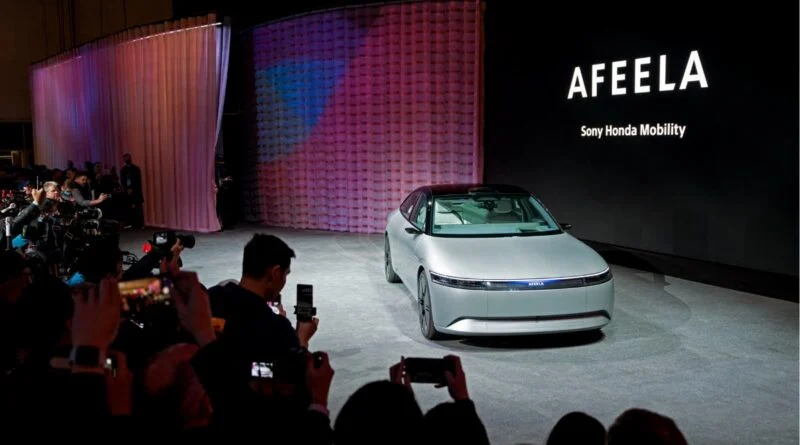
Image credit: CES 2023
The End of a High-Profile EV Experiment
In a stunning development that underscores the brutal challenges facing the electric vehicle industry, Sony and Honda have officially abandoned their joint EV venture, Sony Honda Mobility, and its flagship Afeela electric vehicle project. The announcement, confirmed on March 25, 2026, marks the end of one of the most high-profile tech-automotive collaborations of the decade and sends a sobering message about the difficulty of breaking into the EV market even with two of the world’s most recognized brands.
The Afeela had been positioned as a premium, tech-forward electric vehicle that would combine Sony’s entertainment and sensor technology expertise with Honda’s automotive engineering heritage. First unveiled at CES 2023 to considerable fanfare, the project generated enormous excitement about the potential for consumer electronics companies to disrupt the automotive industry.
What Went Wrong
While neither Sony nor Honda has provided a detailed public explanation for the decision, industry analysts point to a confluence of factors that made the Afeela project increasingly untenable:
- Market Headwinds: The global EV market has faced significant turbulence in 2025-2026, with sales growth slowing in key markets, subsidy cuts in the US and Europe, and mounting consumer debt concerns dampening demand for premium EVs.
- Tesla and Chinese Competition: The EV landscape has become brutally competitive. Tesla continues to dominate the premium segment while Chinese manufacturers like BYD, NIO, and Xiaomi have flooded the market with technologically sophisticated vehicles at aggressive price points that legacy automakers and new entrants struggle to match.
- Development Costs: Building a new EV from scratch requires billions in investment, and the path to profitability has proven far longer and more expensive than initially projected for most new entrants to the market.
- Strategic Misalignment: Reports suggest that Sony and Honda had differing visions for the vehicle Sony prioritizing it as an entertainment and content platform, Honda focused on traditional automotive performance and safety metrics creating friction that slowed development.
The Broader EV Industry Context
The Afeela cancellation is part of a broader pattern of EV project retreats and consolidations in 2025-2026. Several high-profile EV startups have folded or been acquired, and even established automakers have scaled back their electrification timelines in response to market realities.
However, the picture is not uniformly bleak. The Iran war’s impact on oil prices pushing gas toward $4 per gallon in the US has renewed consumer interest in EVs as a cost-saving measure. Analysts note that while premium EV projects like Afeela are struggling, the market for affordable, practical EVs remains robust and growing.
Amazon-owned Zoox is simultaneously expanding its robotaxi operations to Austin and Miami, and Harbinger is developing hybrid emergency vehicles, suggesting that the broader electrification trend continues even as specific projects fail.
What Happens to Sony Honda Mobility?
The fate of Sony Honda Mobility as a corporate entity remains unclear. The joint venture, established in 2022, employed hundreds of engineers and designers across Japan and the United States. Both companies are expected to absorb relevant talent and intellectual property, though the specific terms of the wind-down have not been disclosed.
For Sony, the failure represents a costly detour from its core entertainment and electronics business. For Honda, it raises questions about the company’s EV strategy more broadly, as it now faces the challenge of competing in the electric vehicle market without the tech partnership it had hoped would differentiate its offerings.
Lessons for the Industry
The Afeela story offers several important lessons for the tech and automotive industries:
- Brand recognition and technological expertise do not automatically translate into EV success
- The gap between concept car excitement and production-ready vehicles remains enormous
- Strategic alignment between partners is as critical as technical capability
- The EV market rewards focus, cost discipline, and speed to market above all else
As the dust settles on the Afeela project, the EV industry continues its turbulent evolution with winners and losers being determined not just by technology, but by execution, timing, and the ability to navigate an increasingly complex global market.
For quality tech news, professional analysis, insights, and the latest updates on technology, follow TechTrib.com. Stay connected and join our fast-growing community.
TechTrib.com is a leading technology news platform providing comprehensive coverage and analysis of tech news, cybersecurity, artificial intelligence, and emerging technology. Visit techtrib.com.
Contact Information: Email: news@techtrib.com or for adverts placement adverts@techtrib.com
About The Author
