

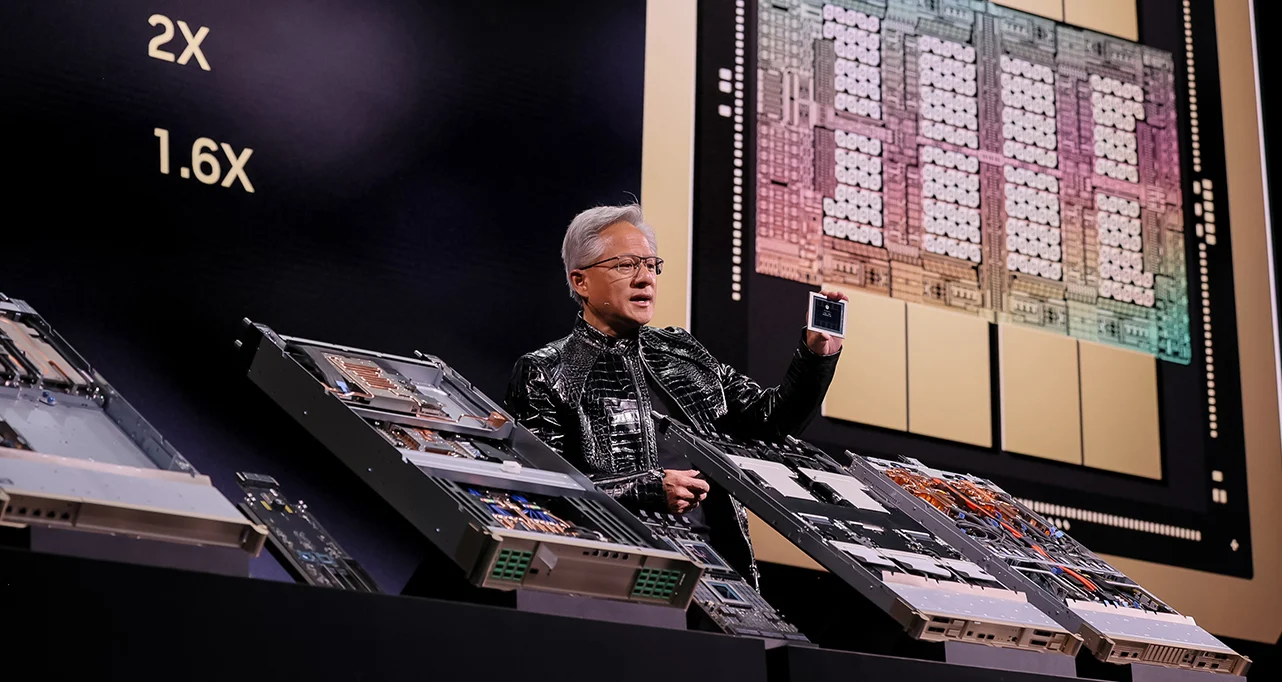
NVIDIA has once again pushed the boundaries of artificial intelligence computing with the announcement of its groundbreaking Vera Rubin AI platform at CES 2026. CEO Jensen Huang revealed this next-generation AI computing powerhouse, claiming it delivers performance that’s 5X more powerful than the company’s previous Blackwell architecture.
Revolutionary Six-Chip Architecture
The Vera Rubin platform represents NVIDIA’s first six-chip AI system, developed using an innovative “extreme codesign” approach. This comprehensive platform includes:
- Rubin GPUs – Delivering up to 50 petaflops of inference performance using NVFP4 precision
- Vera CPUs – Optimized for data movement and AI agent processing tasks
- NVLink 6 networking – Enhanced connectivity for seamless data flow
- Spectrum-X Ethernet Photonics – Advanced networking capabilities
- ConnectX-9 networking cards – High-performance network interface
- BlueField-4 data processing units – Specialized data processing acceleration
Dramatic Cost Reduction and Performance Gains
One of the most significant advantages of the Rubin platform is its ability to reduce AI token generation costs to approximately one-tenth of previous platforms. This dramatic cost reduction could democratize access to advanced AI capabilities across industries.
The platform also introduces the Inference Context Memory Storage system, designed to improve long-context AI processing by increasing both speed and efficiency – crucial for applications requiring extensive contextual understanding.
Industry Applications and Market Impact
NVIDIA positions the Rubin platform to support large-scale AI training and inference across multiple sectors:
- Autonomous Driving – Enhanced real-time decision making
- Robotics – Advanced AI-powered automation
- Healthcare – Accelerated medical research and diagnostics
- Climate Research – Complex environmental modeling and analysis
Market Reality Check
While the announcement has generated significant excitement, Elon Musk provided a dose of reality, noting that “It will take another 9 months or so before the hardware is operational at scale and the software works well.” This highlights the gap between raw technological capability and practical deployment.
Strategic Significance
The Vera Rubin announcement comes at a critical time when AI infrastructure demands are skyrocketing. With NVIDIA’s stock recently hitting historic highs and the company becoming the first to reach a $4 trillion market cap, this new platform reinforces their dominance in the AI hardware space.
The platform’s design philosophy of reducing bottlenecks through integrated codesign represents a significant evolution in AI hardware architecture, potentially setting new industry standards for performance and efficiency.
Looking Forward
As organizations worldwide grapple with the computational demands of advanced AI applications, the Vera Rubin platform promises to be a game-changer. Its combination of raw performance, cost efficiency, and integrated design could accelerate AI adoption across industries that previously found such capabilities financially prohibitive.
The platform is now in full production, marking NVIDIA’s continued commitment to pushing the boundaries of what’s possible in artificial intelligence computing.
This breakthrough represents a significant milestone in AI hardware development, with implications that will likely reshape the competitive landscape for years to come.
For quality tech news, professional analysis, insights, and the latest updates on technology, follow TechTrib.com. Stay connected and join our fast-growing community.
TechTrib.com is a leading technology news platform providing comprehensive coverage and analysis of tech news, cybersecurity, artificial intelligence, and emerging technology. Visit techtrib.com.
Contact Information: Email: news@techtrib.com or for adverts placement adverts@techtrib.com
About The Author
