

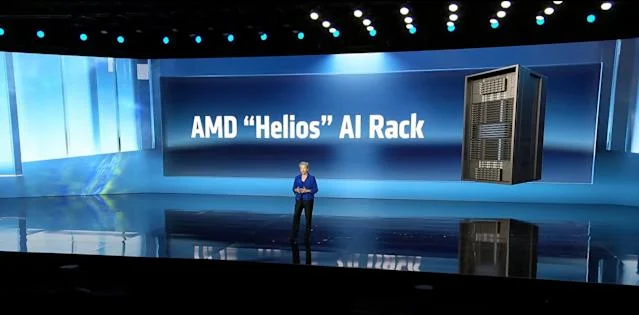
At CES 2026, AMD CEO Dr. Lisa Su made waves with the company’s most ambitious announcement yet: the introduction of “yotta-scale computing” through their revolutionary “Helios” platform. This massive leap beyond today’s data center capabilities represents a paradigm shift in AI infrastructure that could reshape the entire industry.
The Helios Platform: 3 AI Exaflops in a Single Rack
The centerpiece of AMD’s announcement is the Helios rack-scale platform, which packs an unprecedented 3 AI exaflops into a single rack using the new Instinct MI455X GPUs and EPYC “Venice” CPUs. This infrastructure is specifically designed for training trillion-parameter AI models, with industry giants like OpenAI and Blue Origin already testing the technology.
The implications are staggering – this level of computing power could accelerate AI development timelines by years, enabling the creation of AI models that were previously impossible due to computational constraints.
Enterprise-Focused MI440X GPU Launch
AMD also introduced the Instinct MI440X GPU, targeting enterprise customers who want on-premises AI deployments without massive infrastructure investments. The compact eight-GPU design fits existing setups while handling training, fine-tuning, and inference workloads efficiently.
Looking ahead, AMD previewed its MI500 Series GPUs launching in 2027 with 2nm process technology and HBM4E memory, claiming up to 1,000x better performance than the MI300X chips from 2023.
Consumer AI Revolution with Ryzen AI 400 Series
On the consumer front, AMD’s new Ryzen AI 400 Series processors ship this month with 60 TOPS neural processing units and full ROCm software support. The standout Ryzen AI Max+ variants feature 128GB of unified memory, enabling users to run 128-billion-parameter models directly on laptops or small desktops without cloud connectivity.
This democratization of AI computing power puts enterprise-level capabilities in the hands of creators and developers, potentially sparking a new wave of innovation in AI applications.
Edge Computing Gets Intelligent
The new Ryzen AI Embedded processors bring AI processing to cars, medical devices, and robots through the P100 and X100 Series. These chips are designed for tight spaces and power constraints, enabling automotive dashboards, healthcare monitors, and autonomous systems to make split-second decisions locally.
Market Impact and Industry Response
This announcement positions AMD as a serious challenger to Nvidia’s dominance in the AI chip market. The yotta-scale computing vision addresses the growing demand for massive AI training capabilities while the consumer-focused products make AI development more accessible.
Industry analysts predict this could trigger a new arms race in AI hardware, with competitors rushing to match AMD’s performance claims. The timing is perfect as AI companies are increasingly hitting computational bottlenecks in their model development.
What This Means for the Future
AMD’s CES 2026 announcements signal a fundamental shift in how we think about AI computing. From trillion-parameter models in data centers to 128-billion-parameter models on laptops, the democratization of AI computing power is accelerating rapidly.
For businesses, this means more options for on-premises AI deployment. For developers, it means unprecedented local AI capabilities. For the industry, it means the AI revolution is about to get a major acceleration.
As we move through 2026, AMD’s yotta-scale vision could be the catalyst that transforms AI from a cloud-dependent technology to something that’s truly ubiquitous across all computing platforms.
For quality tech news, professional analysis, insights, and the latest updates on technology, follow TechTrib.com. Stay connected and join our fast-growing community.
TechTrib.com is a leading technology news platform providing comprehensive coverage and analysis of tech news, cybersecurity, artificial intelligence, and emerging technology. Visit techtrib.com.
Contact Information: Email: [email protected] or for adverts placement [email protected]
About The Author
